Flooring The Consumer on Simple Marketing Now

Please visit Flooring The Consumer's new home on SimpleMarketingNow.com where you can subscribe to receive updates to blog articles in real time!

Monday, June 15, 2009

Rethinking the Mall & Uncovering Retail Creativity

Mosaic Mall originally uploaded by /\ltus.
What's next for retail? How to reinvent the mall experience? How to adapt to 'changing consumer attitudes about consumption' and the desire for more sustainable environments? Start by reading the article Allison Arieff from The New York Times wrote on 6/1/09. It's titled Rethinking the Mall and reviews entries to the inaugural ICSC Future Image Architecture Competition.

In addition to touching on some of the retail frustrations I've encountered in Las Vegas, she expresses disappointment that so few of the entries "paid [attention] to things like sustainable architecture, alternative transit or changing consumer attitudes about consumption."

However, Arieff highlights intriguing concepts around rethinking the mall, looking at human behavior in conjunction with physical space and at "technology not as some sci-fi fantasy, but as something that could enhance not only the shopping experience but environmental and social conditions as well."

One example reexamines the relationship between customer and retailer, to offer services like:

- "assist[ing] consumers in budgeting for purchases"
- how to deal with the "brilliant dilemma of 'after-wear' management"
- allowing customers to "donate a percentage of their purchase price to charity"

No surprise, "walkable mixed-use community" comes up -- enhanced for "multi-modal access [not just car but rail, transit and pedestrian]." Social center, too [the author brings up The Ainsworth Collective in Portland Oregon's Cully neighborhood as successful interpretation of a local, cause-oriented retail mall]. Another concept refers to "self-sustaining, self-generating scenario of distributed shopping experiences" that work hand-in-hand with iPhones for easy purchase online. And, yet another concept specifically addresses the "powerful forces shaping a retail renaissance... Internet, social networking, women, food, energy, sustainability factors will determine their [i.e., surviving retailers'] functionality, form and location."

In addition to validating previous posts like Injecting New Life Into Dead Malls, Getting Ahead By Being Local and Retail Experience of the Future, what I appreciate from this article is that there's wonderful creativity yet to be uncovered at retail. And, although about malls and rethinking the mall experience, the learnings, observations and possibilities from this article are much wider-reaching. They are relevant to any retail experience.

David Polinchock makes that same point in his post Rethinking the Mall - Allison Arieff Blog - NYTimes.com, touching on the growing trend to "socialize the retail environment instead of just merchandising the real estate space."

I don't think that the Sears new test concepts [see Sears tests MyGofer prototype store in Joliet] is the answer.

But, look at how museums are socializing their spaces. Intriguing, don't you think?


The question then becomes: how do you socialize YOUR retail space -- regardless of the product category?

----------------------
Other posts that address 'Rethinking the Mall':
+ From Labelscar: The Retail History Blog, see New York Times on Rethinking the Mall.
+ From Greater City: Providence Blog, see Rethinking the Mall.


Technorati Tags: Del.icio.us Tags:

Friday, June 12, 2009

Meet Carl Ruland - Floor Covering Institute Series

Back in April, I announced in Whittemore Joins Floor Covering Institute that I've become part of the Floor Covering Institute - Jim Gould's global flooring consultancy. We've started discussing, planning and imagining exciting possibilities and I'm discovering how talented my fellow members are. So much so that I thought you might enjoy 'meeting' them and learning more about them. I plan, then, to introduce each one to you individually, starting with Carl Ruland.

Carl Ruland is president of Global Flooring Consulting, based in Bonn, Germany. A true European, he speaks many languages in addition to his native German [an opportunity for me to brush up on the German I learned many years ago in my French-speaking school in Abidjan, Ivory Coast! Luckily, he also speaks French...]. He also has an affinity for cultural and marketplace differences that can make products like flooring challenging to sell -- as you can appreciate from his responses below -- if you don't know the lay of the land.

C.B.: Carl, please tell me about yourself - your business, your expertise, etc.

Carl: Yes, indeed, I am a true European and Europe is a fascinating continent with 27 countries, 25 Languages, 500 million people.

Consumers in Italy like tiles and natural stone; in the UK they install broadloom carpet even in bathrooms; in Austria they buy mainly wood floors.

In Germany you have the highest density of DIY stores in the world; in the UK the majority of flooring is sold through wholesale and in the Netherlands you have the small shops-around-corner.

There is a CE mark, which marks the European conformity of products; however if you want to sell to the public building sector in Germany you need additional certifications which are different from the ones you additionally need in France.

I have gained considerable experience from 25 years in senior positions in companies that produce solid wood, engineered wood, laminated flooring, broadloom carpet, vinyl sheet and vinyl tiles and can help flooring manufacturers that want to do business in Europe better understand the marketplace. Perhaps they need help with a market survey, market research, M&A, strategic sales network, portfolio strategy, or even product certification.

I speak 5 languages [see Carl's LinkedIn profile: German, English, Dutch, Danish and French], I have worked and lived in three European countries; I have travelled to all of them and done business in most of them.

Some examples of my work: I have established original equipment manufacturing business for a European manufacturer in the US, pioneered laminated flooring in China, realized a multi-million Euro investment in a manufacturing plant in Europe and help different management team positions including product management, sales- and marketing management and general management.

C.B.: How did you get started in the flooring business?

Carl: 25 years ago as a manager of retail sales at a wood wholesaler and retailer in Bonn I noticed a growing demand for engineered wood floors. This growing demand was driven by consumers while the installers still wanted the traditional stuff: 1 inch thick, 2 inches wide and about 24 inches long solid parquet.

So I began to realize that the core of contention was not between industry with pre-finished products but with installers with their experience and craftsmanship. It was the beginning of a new business model for my traditional wholesale company: we began to import directly from producers in Sweden, Finland, Italy and Malaysia and started distributing this in Western Germany to installers. I had left sales and was in business.

C.B.: What do you like most about flooring?

Carl: Unlike most other industries where you always meet limited users, literally everybody on this beautiful planet stands on a type of flooring. So this will be a never ending learning curve about differences in climate conditions, architecture, engineering, design, taste, application..... (this sounds a little bit like Bubba in Forest Gump).

C.B.: What do you like least about flooring?

Carl: Poor quality that destroys consumer acceptance, leads to no-profit and produces even poorer quality.

C.B.: What opportunities do you see for the flooring industry?

Carl: The biggest opportunity for the industry is that flooring provides the biggest surface in a building that remains unchanged and unmanipulated. Flooring will be installed as manufactured and supplied by the industry. In other terms: the industry itself determines the quality, design, life cycle, etc. of the floor. This is a huge opportunity and a huge responsibility. I see, and maybe this is a very European vintage point, the opportunity from three main areas:

Ecology

In the future not only the use of ecologic material is important but the ecology along the entire value chain, from raw material, production, transport to the point of sale. What seemed to be the whim of a relatively limited group of LOHAS consumers will be more and more KO criteria for the entire business model. Reach, Leed, Low Carbon, etc. are regulations that force the industry to look at things through green glasses. Those companies that realize the importance of this approach and that are able to adapt their current business to this future model will not only survive but will make profit. It offers the chance to reformulate the business strategy to either differentiation with low volume and high profit or penetration with high volume and high profit.

Quality, Design and Sustainability

I see a big opportunity in the respite of this current crisis. Product quality, design quality and architectural sustainability should be big drivers for the flooring industry in the future. Value for price should matter again, world class designers should create appealing floors and all application should be sustainable in the sense of: if I am installing this can future users continue to use this or change it with reasonable efforts?

Re-cycling

A German professor, now teaching in the Netherlands, asked the question why most people mean downcycling when they speak about recycling. We all know that recycling cost money both in landfill and re-use. Other than in the past where the value chain for the flooring industry stopped at the cashier the chain should continue, as all flooring removed from a building can be converted into another flooring. This costs money, but could generate contribution for our industry.

C.B.: What do you see being the greatest advantage that the Floor Covering Institute offers?

The big advantage of the Floor Covering Institute is the versatility of the expertise you can find there. Where else outside a company do you find a group of experts in flooring that go from 'is the subfloor good enough for installation?' to 'how do you think should I approach the market for my high end product?', and from 'can you help me to find a source in China?' to 'do you think this would sell in Russia?'

Danke schรถn, Carl!

Comments, questions, feedback?

I am fascinated with the glimpse that Carl offers us of the European marketplace and its complexity as well as his perspective on the opportunities ahead for the flooring industry.

Technorati Tags: Del.icio.us Tags:

Wednesday, June 10, 2009

Jeanne Byington on Bridging New & Old - Social Media Series

This week's guest for Flooring The Consumer's Social Media Series: Bridging New & Old is Jeanne M. Byington.

Jeanne Byington, an accomplished public relations and marketing consultant, is principal of NYC-based JM Byington & Associates, Inc.. She's also passionate about excellent customer service, a topic she addresses in her blog, The Importance of Earnest Service. Look for Jeanne on Twitter as JMByington.

I met Jeanne through David Reich of My 2 Cents who thought we would have plenty to talk about given our common home furnishings background. He was right! But, there's more as you will discover when you read what she has to say about Bridging New & Old.


C.B.: Jeanne, how and why did you get involved in social media?

Jeanne: I’m involved in social media to communicate--for the same reason at one time I learned to use a computer, BlackBerry, e-mail as well as a few phrases of Turkish when I lived in that country for two years. I feel claustrophobic when I can’t. Guess that’s why I’m in communications.

I started with a blog and coordinating web site. I did for my business precisely what I advise clients to do: increased its visibility. This is no time to shut down communications initiatives. Invest time and money to promote your business, its products and services, in spite of less than spectacular economic outlooks and income projections. Might as well close shop if you don’t let others know what your company is doing.

Today’s information comes faster and faster in tinier and tinier bytes. Pelted by it night and day, people’s attention spans/memories shrink. Participating in social media keeps your conversation in play and your business in focus in potential and actual customers’ lines of vision in cost-effective ways.

I use my blog as an evolving case history, an effective way to illustrate many ways to dice and slice a single concept. The blog gives dimension to my web site.

People have promoted and publicized products and services in a range of lights for eons using traditional PR methods from press releases and speeches to PowerPoint slide shows, newsletters and bulletins.

The same core PR technique applies to a blog or to tweets: They can’t be too commercial or self-serving.

The blog led me to explore LinkedIn, Twitter and Facebook to promote my business, bring traffic to the web site and blog.

Web sites in combination with blogs are today’s business cards. Twitter allows a company to speak directly to its clients. It doesn’t require passing through gatekeepers.

C.B.: What do you like most about social media?

Jeanne:

+ I’ve met great people through my blog, some are strangers and all take precious time to share their expertise with me in guest posts and comments. I’m surprised at how simple it is to publish and illustrate posts [though it can be complicated to comment on some people’s blogs. I wonder why they make it tricky as there are simple, effective ways to control what’s posted].

+ I’m always thrilled when I find someone on LinkedIn whom I couldn’t otherwise locate or when a former contact finds me. And the groups, such as public relations and communications professionals on LinkedIn, hold promise.

+ From my Tweetdeck, I get news-as-it-happens from the New York Times and am often first with what may be an important development for a client or colleague.

+ Google Alerts act as a free clipping service and monitor.

+ iPods are amazing and promise marketing opportunities we can hardly fathom. Turn pages of a downloaded book with your finger in a far more realistic simulation than changing pages on a Kindle. Speaking of realistic, I watched beer fill the screen as if in a glass and was waiting for it to leak on my hand.

+ I’m fascinated by YouTube and its potential marketing applications. Social media tools link to some great video segments.

C.B.: What do you like least about social media?

Jeanne:

+ It’s a time-gobbler. Like wild hair, it needs to be tamed. I don’t want to receive tweets on my BlackBerry, so apart from direct messages, I don’t. I resent the hours it takes to identify people I should follow on Twitter for my business, though I wouldn’t mind spending that time on behalf of a client.

+ Some of the tools have multiple personalities, with applications for business, pleasure, the trade and consumers all at once. I’m so used to targeting messages. This was a recent tweet: “WOW, upstart bit.ly is now bigger than tinyURL: http://bit.ly/18Dghk - maybe its bc bit.ly is 6 char. & tinyURL is 7.” I know what it means, but do I care?

+ I’m awestruck by how self-centered some people are to think I’d be interested to know that they attended a meeting or trade show or film or were planning a vacation, returned from the beach, landed in Chicago and the like. I’m not their Mom. Is this spam-like sharing on LinkedIn, Twitter and elsewhere a lack of judgment? People should more carefully target who gets what information. It’s no different than sending out information to the press. News of a new flooring collection doesn’t go to a fashion accessories editor. If someone’s attended a trade show and they have something important to tell me about it, then write me, not all of their 328 contacts.

+ In addition, there are too many social communities. Who can participate in them all? I don’t like having to reject someone by refusing their invitations to join so I write a polite e-mail as to why I can’t. It’s like belonging to too many associations: Impossible to take advantage of the many updates and opportunities that seem to grow geometrically.

+ Finally, I have a big problem with trust these days. I am reluctant to use Facebook or LinkedIn to initiate and reply to messages. You want to reach me? Send me an e-mail or call. [I’ll get used to it. Some considered risky the first ATM machines.]

Meanwhile, don’t you ask a person you’d like to do business with whether they’d prefer to communicate by phone or e-mail?

C.B.: How has social media changed how you interact with the marketplace as a consumer or customer?

Jeanne: While the Internet has totally changed the way my family interacts with the marketplace—buying and selling stock; buying airline and train tickets; finding the nearest branch of a store; specking out the styles a store carries; buying books on Amazon.com; using for other things the space formerly taken up by printed directories and so forth, I can’t say that social media has changed how I interact with the marketplace as a consumer or customer.

Feeling insecure about being so out of it, I asked a 23 year old friend who works for a website—her second job in that industry. She thought of one instance—she admired a friend’s photos on Facebook and hired the photographer to take her wedding pictures.

I continue to get a tremendous amount of information from traditional media. From The New York Times I read that only 40 percent of Twitter users in February returned to the site in March and about Stephen Wolfram and his search tool, WolframAlpha. [On the other hand, my husband reads 98 percent of his news on the web.] I also hear about travel bargains on the radio.
C.B.: What 5 suggestions do you have for companies to implement so they can more effectively bridge old media with new media and connect with end users?

Jeanne:
1) From medical to marketing, ours is a country of specialists. You don’t have to explore the world of social media yourself if it holds no interest or you have no time. Just as you’d hire a video expert to produce and place a satellite media tour [SMT] or graphic designers to create fabulous merchandisers, web sites and logos, there are experts, such as Christine Whittemore, [Thank you, Jeanne!] who can hold your business by the hand and guide you to select new media options.

2) Speaking of video experts, you don’t want your YouTube videos to look like loving hands at home. Best use a professional. A company that conducts excellent SMTs would be the place to start. Staff has a nose for news and marketing as well as the video expertise to advise and provide a topnotch product. Paul Gourvitz, Gourvitz Communications in New York is A++.

3) Hire professional writers for your new media marketing materials otherwise you’ll lose readers as quickly as a click of a mouse. Ideally, the writers should be succinct and clear and sensitive to marketing and public relations issues. Faux pas travel fast.

4) When the Internet became popular as a marketing tool, many businesses largely dropped everything else and spent the majority of their marketing budget on their web site. Trouble with that was that nobody knew that they had a web site. Consumers weren’t Internet-savvy and didn’t Google. A company still needed to promote its site in traditional ways—through newspapers, radio, TV, trade and consumer magazine publicity and advertising.

No different today. You need to orchestrate your options to remind people that you are there and tap more than one note. Zagats does a good job. They have a 30th anniversary contest going on that you can participate in daily, but who remembers? They help remind with e-mails along with traditional and more innovative bells and whistles that direct you to their web site. Some restaurants, hoping you’ll give them a good review, provide handouts to the site. I passed a bagel shop on Third Avenue in NYC with a handmade sign on its front door, asking you to vote for them for “best bagel” on zagat.com. [They actually do have the best bagels.]

Like the early web days, some customers aren’t up-to-the-minute on technology. They still read, see and hear newspapers, TV and radio respectively. Don’t forget them. And now that we don’t get that much anymore, mail stands out.

5) Minding the basics is critical because consumers know how to spread news of their discontent through social media and the Internet as efficiently as a company can boast of its benefits. It’s easier to erase words etched in stone than to eliminate negative news from Google and other search functions.

Social media is exciting, energizing, efficient and relatively inexpensive, but toll-free number operators still need to be informed to provide accurate information, sales staffs must be knowledgeable and courteous, products have to work and customer service teams must be patient and compassionate problem-solvers or you’re wasting your time focusing only on social media to show how hip your company is.

C.B.: Any other thoughts to share about the effectiveness of social media in forging stronger relations with customers and how best to do so.

Toss out your calculators and cost per million stats. You’re communicating with clients and customers in a different way and traditional measurements—that some dispute, especially in PR, in any case--don’t apply. For example, tweets are conversations, not midget advertisements or endorsements. You can also use the technology to hear what’s being said about your brand while remaining silent with your brand’s ear to the ground. And as you’ve always done, understand the benefits and limitations of each option you decide to pursue so you know what to expect.

Thank you, Jeanne!

Comments? Questions? Reactions?

I love that Jeanne approaches social media tools with her clients specifically in mind.

She brings up an interesting point with respect to Twitter: how to target information effectively given one's audience. As Twitter transitions from a narrow-cast medium to a broadcast one [I am stunned by the number of folks with 20K+ Twitter followers deciding to follow me lately. What gives? How can anyone make meaning from the tweets of so many?], Twitter will need to evolve and offer users more effective means of truly receiving and sharing relevant content. I'm curious, though. What kinds of effective work arounds have you developed?

For that matter, how do you deal with the onslaught of communities and groups to join?

What about Jeanne's suggestions for more effectively bridging old media with new media? How might you implement some of those ideas?

For additional insights from participants in the Social Media Series: Bridging New & Old, please visit The Entire Bridging New & Old Series.

Technorati Tags: Del.icio.us Tags:


Monday, June 08, 2009

Digital and the Retail Experience

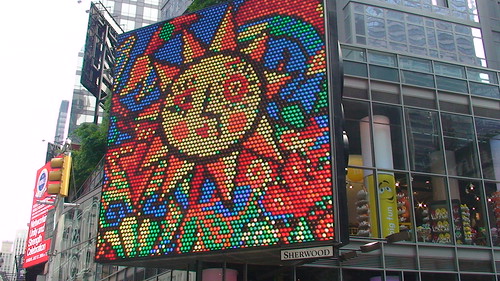
Times Square (NY City) digital signage originally uploaded by POPAItaly.
Have you considered how digital technology and signage might affect, even radically improve, your retail experience?

I recently became re-acquainted with Andy Edelman from Trimco, a New York based visual merchandising display company whose organization has enhanced the in-store experiences of many major retailers - e.g., Ann Taylor, Bloomingdale's, Harley-Davidson, Disney, JC Penney, Victoria's Secret, Macy's, etc.... - around the country. Andy and I had both been invited to sit in on Brand Experience Lab's David Polinchock's FIT class final presentation and listen to, react to and evaluate the students' retail makeover recommendations.

Andy and I got to talking -- how often do you get to interact with someone who has single-handedly 'touched' in some way just about every noteworthy retail experience? -- about retail displays and the role they play: to capture the attention of a public that expects retail to be an experience, yet has less time and wants to get in and out of stores rapidly.

Digital, you see, can radically improve a retail experience by educating, entertaining and creating a consistent and up-to-date visual environment. Digital can do that despite inconsistent in-store sales assistance.

Take mannequins. It takes a great deal of manual effort to change them and re-dress them [!] to reflect new seasonal items. Consequently, they don't change frequently. Digital mannequins, on the other hand, can be updated at the push of a button to coincide with different day parts or different shopper patterns.

Here's a frightening bit of information: only 60% of point-of-purchase materials actually ever get set up in-store. Talk about waste! Digital guarantees that updates take place.

[By the way, I can attest to the truth of that statistic. If we ever had in-store promotions planned to coincide with the launch of new Wear-Dated display programs, we had to send our Wear-Dated Representatives out ready to go into warehouses, dig out cartons, extract the display parts, get them set up and the product samples properly organized within the displays. Otherwise, the displays and associated products never saw the light of a retail store - or the inside of a consumer's home.]

To illustrate what's possible, Andy shared with me this video link to an interactive retail window. It's new technology, definitely cool and fun and brings to life how digital displays can enhance the retail experience, engaging consumers and inviting them to interact with displays at a higher level of involvement than traditional displays do.

What do you think? Pretty cool, no?

Contrast that with WSL Strategic Retail's visual virtual tour of Target's new Beauty Department concept being tested in several stores in and around Wheaton, IL. Note the oversized, visually captivating and attention getting photos and graphics. I don't see much digital technology involved here... although the visuals create an eye-catching effect. [Imagine, though, bringing in-store via digital technology the online DailyCandy experience - see Target Offers Taste of DailyCandy - to enhance the strong visual presence.]

Questions for your consideration:

How would you apply this kind of technology to your retail environment? What if a consumer could design a room on-screen or on a store window? How would you use it to enhance the value of the products and services that you offer? How might you completely redefine, re-imagine and re-value the flooring retail experience - or any other - as a result?


Technorati Tags: Del.icio.us Tags:

Friday, June 05, 2009

LMNOP: An A&D Networking Community

Back in my Wear-Dated, Ultron and Carpetology days [to think it's only been 2.5 months since those days!], I came into contact with A&D or Architecture and Design professionals. After all, Solutia [now Ascend Performance Materials] was actively engaged with that segment via the Ultron carpet fiber brand, the yearly Doc Award Competition, a permanent showroom at NeoCon and other programs. So, when I learned from a former NYC-based Ultron representative about LMNOP - Leadership, Mentoring, Networking & Opportunity for A&D Professionals and a new organization specifically for the A&D community, I was intrigued.

In A&D Professionals Form Networking Society in Interior Design magazine, you can learn more about the organization, its efforts to prevent a 'talent gap' in the architecture and design industry, and the events being offered.

The press release announcing the organization's formation is available at Contract Magazine in "Disaster Relief: Leadership, Mentoring, Networking & Opportunity for A&D Professionals (LMNOP) is Born." From that release:

"LMNOP is composed of several different factions; Jennifer Graham heads the "Leadership Group" with co-founder Stephanie Chiuminatto who is charged with setting the vision and agenda for all group events. The core unit and reason for the group's establishment is the "Opportunity Group," made up of unemployed architects and designers ranging in experience from 2 years to 20 plus years. Employed professionals are "Networkers" who can assist other members in connecting with possible employment opportunities and provide support and encouragement as well as notify members of industry events. All members can participate in the "Mentoring Group," professionals that donate their professional expertise to the group either individually or in a workshop setting.

Workshops are regularly held for Opportunity members and include topics such as "The Job Search Checklist" and "Your Personal Professional Brand." Topics are chosen based on the timeliness of the subject. Accessibility to similar workshops in professional development and leadership training may only occur in a handful of the largest architecture and design firms, and similar business workshops are not specifically tailored to the A+D community. All workshops are held as small round-table discussions at various showrooms around New York City. Because of the intimate and interactive nature of the workshops, the Opportunity Group is kept small; new members are referred in by existing members. Networking events are open to all LMNOP members and often double as fundraisers in the group's overall objective to develop into a fully-realized non-profit organization."

I really like the notion of employed networkers and unemployed opportunity group members interacting. Imagine the knowledge exchange and learning opportunities possible for both groups!

I reached out to co-founder Stephanie Chiuminatto, Associate IIDA, LEED AP. She explained to me that membership has been coming primarily through word of mouth. Leadership members are actively networking, and oftentimes people approach members at events asking how they can get involved.

She expects the LMNOP website to be up and running in the next month or so.

In the meantime, if you have questions or know of NYC architect and designers - employed or not - wanting to get involved, please contact Stephanie directly at schiuminatto [at] gmail [dot] come.

On a related note, I learned that The Mohawk Group has established Re:work program. Per FloorDaily.com "Mohawk's Re:work seminar series designed to provide unemployed designers and architects help in securing future employment. In this 10 city tour, Mohawk, the IIDA and Interior Design Magazine have teamed up to provide A&D professionals with outplacement assistance that includes portfolio evaluation, financial planning, resume writing assistance and job opportunity networking services."

You can learn more from an 8 minute interview with Al Kabus, president of The Mohawk Group, who discusses The Mohawk Group's Re:work Program with Kemp Harr from FloorDaily.

Given these terrific programs and organizations, have you considered how you might support networking in your community? Could you host events in-store? What about sharing meeting space or even offering your own expertise? I bet you will be pleasantly surprised at what develops.

I've been sharing my expertise in networking groups and am astounded at what I'm learning.

Technorati Tags: Del.icio.us Tags:

Wednesday, June 03, 2009

Valeria Maltoni on Bridging New & Old - Social Media Series

This week's guest for Flooring The Consumer's Social Media Series: Bridging New & Old is Valeria Maltoni.

Valeria Maltoni - aka Conversation Agent - redefines conversation and community by connecting ideas and people. She carries those conversations over to a multitude of venues, both online and offline, further nurturing and developing them. Read her biography and you'll understand. Better yet, read her blog, Conversation Agent, learn What does Conversation Agent do? and you'll realize what an amazing Renaissance woman she is.

"How do You Say "Just Do It" in Marketing 2.0?" represents Valeria's chapter in The Age of Conversation 2 - Why Don't They Get It? - the book that 237 authors from around the world collaborated on to benefit Variety, the children's charity. [Per a previous post, The Age of Conversation 2 - Why Don't They Get It? is now available on Amazon for purchase.] The advice she shares in her chapter captures the essence of bridging new and old: "The one thing you can definitely control is how you relate to your customers and what actions you take to respond to their needs. That is Marketing 2.0."

Valeria brings an unique perspective to conversation -- not just because of her bi-cultural experiences -- but also because she is both corporate marketer and active in Marketing 2.0, epitomizing what bridging new & old is about.

C.B.: Valeria, how and why did you get involved in social media?

Valeria: I didn't really or specifically think bout the media part, to me it was about getting social and online was a way to do that. At the time I was working in Northern New Jersey and had this long commute to and from where I would have plenty of time to think about organizing my day's activities. Since I was driving the 80 or so miles each way, I would also listen to fiction books on tape. Remember this was almost 10 years ago.

I'd discovered Fast Company magazine through my managing director who then became CEO and is still my mentor. When it comes to learning I'm a sponge, and having so much actionable information was ideal to me. FC was also the first publication I read that really believed in the power of helping people make connections with each other. It was probably the work of a team, but Heath Row became the living proof that it could be done and the main contact for the community.

I got involved because to me learning is about putting skin in the game and growing up in a culture that values and encourages (at least at that time) conversation and the free exchange of ideas (have you ever talked to an Italian?) that was a natural step. Fast Company was new media in beta since 1995.

The rest, so to speak, is history. The social network I helped develop and then curate in Philadelphia grew to 500 people and 98 free events. Roundtables with idea people on technology and innovation, networking boot camps, conversations with authors like Ben McConnell, Dan Pink, Bill Taylor and Polly LaBarre, in depth visits with CEOs like Pernille Lopez of IKEA or Glenn Senk of Anthropologie kept things interesting. We partnered with local business schools - Villanova, The Fox School of Business at Temple U., LeBow College of Business at Drexel U., and even Wharton.

That's how I also developed an understanding of digital group dynamics, and learned about facilitating discussions with an online community. Starting my blog was a natural outcome of all of these activities. I wanted to share more information and content, and I love writing while I learn. The blog also allowed me to distribute what I know more widely so that more people can (hopefully) find what they are looking for - a connection to someone else, or to an idea that helps them execute on theirs.

C.B.: What do you like most about social media?

Valeria: In many ways social media has made it easier for us to be social, to share, learn, find information, communicate with each other, connect, etc. without boundaries. The freedom it gives us, which comes with some fundamental responsibilities, is liberating (no pun intended).

As a native Italian, relationships are very important to me - and they are for life. I'd also like to stress that it's not about the tools. I can give you lots of tips about how to use Twitter or LinkedIn but I cannot teach you how to bring the best out of people, or how to change your attitude if you want to or feel the need to adjust it. Those are decisions and choices you need to make.

That is also part of the beauty of the social Web. It brings out the potential of human kind and often the best way online is the best way offline - leading brands just lead.

C.B.: What do you like least about social media?

Valeria: Well, these are permanent digital records, and sometimes people forget that there are consequences to their actions. In the same way as positive gestures are amplified, so are negative ones. Peer pressure, or general dissatisfaction can manifest themselves in unpleasant ways online.

Lack of critical thinking, or not allowing fair discussion bother me. Then again, it's not my place to try and change others, all I can do is improve my own attitude and behavior.

C.B.: How has social media changed how you interact with the marketplace as a consumer or customer?

Valeria: I've become more frugal, actually. Maybe I'm going back to my roots. In Europe we have so much less of everything, or maybe it's that way in my family. And we don't resent it, we feel we have enough. I've always sought connections with people and with ideas and having more of those thanks to the social Web has made me realize I already have all I need.

As a marketer, I pay attention to how people like to receive information, when they seek to be educated or entertained, where they see value, which is not necessarily where the company projects it. I was always the odd duck in school and in corporate America - the one asking more whys than teachers and teams were willing or able to respond to. It's natural curiosity and I bring that to my job. So I question the official role and let relationships and what I learn in conversations with customers guide me on better approaches.

Then again, I was not trained as a traditional marketer. I come to the profession from communications, linguistics to be exact. The Liberal Arts education I received is worth gold today. Think about it - sociology, history of language and communications, philosophy, even anthropology and ethnographics and psychology all teach us about people, us.

Those companies that get my business long term are available to interaction. Period. You may not tweet or blog, like Apple, but if your product rocks and your customer support is superb I don't care. I think many companies are confusing the tools with the business they're in. If your business is to provide a product or service, then that is your starting point for interaction with customers. Social media is the cherry on the top, it's not going to make a product or service that is lacking better.

C.B.: What 5 suggestions do you have for companies to implement so they can more effectively bridge old media with new media and connect with end users?

Valeria: I should have held my advice for this question.

1. Start with your product or service - what do you need to do to make it a valuable use of your customers' budgets and time? If you feel you need to improve it, but do not know where to begin or what, do open up the communication lines with your customers. This is the same deal as the employee suggestion box, it cannot be just lip service, you'll need to walk the talk.

The main difference between old media and new media is the filter - with new media you have none. That can be really good, or really bad for you. You decide.

2. Integrate CRM with social to build long term relationships - the fundamental shift between your CRM system and the social Web to build relationships is that CRM is really a process where you capture and manage customer information. The social Web allows you to act publicly on that information to benefit your customers as well and not just you. Big shift in thinking.

If you want to connect with end users, begin by not seeing them as something you can use and broaden that definition to include how they can use your content to become smarter, do their job better, look good with their boss, etc.

3. Educate your company on new media - don't take for granted that just because everyone's on Facebook they know how to put these tools to good use for business. Set up training classes for your authors and content owners to help them see the possibilities. We're doing that in my organization as part of the media training program we offer. We share information on how we talk about what we do, our stories, what we've published in traditional media, what resonates with our audience (their readers). That kind of intelligence allows subject matter experts to build on existing conversations.

Teach people how to write for the Web and you'll be able to publish more content that is of value to your customer community. It's the old adage of teaching people how to fish. All those who are in customer-facing jobs should be empowered to assist customers wherever they choose to communicate with you.

4. Listen, test, adjust frequently - don't wait until you have the perfect answer. Start testing small initiatives by integrating them to existing programs and keeping them modest. What you want to do is set up realistic objectives, communicate them to your team, and measure against them. Keep listening for changes in behavior and adjust your tactics or strategies accordingly.

This may feel a bit squeamish for those who are classically trained in marketing. They tend to have very specific ideas of what needs to be done. Yes, gone are the days of perfect mass marketing campaigns. Today it's more about micro interactions - personal, relevant, and meaningful exchanges of value. You capture someone's attention when you stop thinking of them as eyeballs and start thinking in terms of exchange.

5. Know where your customers are and why they're there - you may think that having an ad on Facebook is a good idea, after all many of your customers are there. Before you go ahead and find a new way for them to ignore you or piss them off, do take the time to find out why they're there, what they do. Many of the customers I talked with say they signed up to share photos with their grandchildren and find old college room mates. That is a very personal reason and although personal and professional are bleeding into each other more and more, they are in the driver seat here, they decide.

Digital and online media by its very nature feels more personal. People have come to expect interaction and exchange. Instead of ignoring you, like they did off line when you interrupted them last, they may tell you what they think about your ad and they may tell all their friends, too.

C.B.: Any other thoughts to share about the effectiveness of social media in forging stronger relations with customers and how best to do so.

Valeria: Make things easier for your customers. Give them more ways to reach a human being at your company. Especially now that things are tight, whether you're in B2B or B2C, be responsive, get the whole organization on the same page on delivering superb customer experiences, wherever your customers decide they want to talk with you.

Social media is the modern version of the telephone. You've still got to deliver on your promises.

Thank you, Valeria!

Comments, questions, reactions?

I love Valeria's recommendations for educating your company on new media. Are you doing anything along those lines? How is your company using the information to improve the customer experience you offer?

For additional insights from participants in the Social Media Series: Bridging New & Old, please visit The Entire Bridging New & Old Series.

Technorati Tags: Del.icio.us Tags:

Monday, June 01, 2009

Retail Innovation and Urban Outfitters

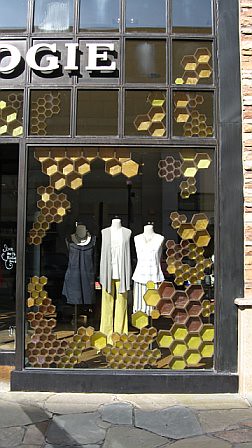
[Anthropologie] Salt Lake City Utah store window for bees
originally uploaded by Anthro_Creative.
When you think 'retail innovation,' what comes to mind? I immediately think of Urban Outfitters. I routinely refer to them in presentations about the retail experience and strongly encourage retailers to spend time visiting any of their stores - Urban Outfitters, Anthropologie, Free People, Leifsdottir, Terrain... - for inspiration.

Inspiration of all sorts. In terms of how to create a retail experience within a store, how to be truly customer-centric, and how to celebrate events both locally and nationally.

Take Anthropologie and Earth Day and marvelous displays calling attention to honey bees across Anthropologie stores around the country. In San Jose, CA, in Boise, ID, Rockefeller Center, NY, Salt Lake City, UT, Georgetown, DC, San Francisco, CA, ...

[Note: Imagine having a store concept so engaging that photos of your windows get posted and viewed online.]

You see, as is typical of Anthropologie and Urban Outfitters stores, no two stores or store windows look the same, nor are they laid out the same. And, yet, the commonality of theme in a variety of interpretations only strengthens the message, drawing visitors into stores.

This WSJ.com article titled "Urban Outfitters Fashions Growth Plan" by Jennifer Saranow from 8/27/2008 highlights what differentiates Urban Outfitters from a plethora of mostly colorless retailers.

Per the article "... employees create their own displays."

Urban Outfitters' CEO, Glen Senk, intends to "cap growth for each division at approximately 250 stores... rather than saturate the market with cookie-cutter stores." Additional expansion would result from new retail concepts instead.

Concepts like We The Free as described in DDI Magazine's "Urban Outfitters launches We The Free" from February 2009, or Terrain [see August 2008 DDI Magazine's "Retail offshoots abound despite tough economic environment"] the goal of which is to "transform the local garden center into an experience that celebrates the beauty and abundance of nature while offering an eclectic mix of garden-inspired products tailored for the contemporary consumer." [Note: digital copies of articles no longer available. Check out PSFK's Store Visit: Return To Terrain from 3/26/2009].

[Another PSFK article - Urban Outfitters gives artists a window for a message - further describes the company's commitment to creativity and community.]

This Fast Company interview with Melinda Davis and Glen Senk: Do You Offer Your Customers What They Really Want? further puts Urban Outfitters into perspective. Senk considers his organization 'customer experts' rather than 'category experts.' What a major difference. He refers to his stores as offering a sensorial experience and telling a story. His stores are like a community where people come to connect.

Customer experts.

Stores are places where people come to connect.

Wow! I consider that not only inspiring, but really unusual. Imagine if flooring stores became customer experts rather than flooring experts. If people came to connect in these flooring customer stores, how would that look?

------------------------
For additional perspective on CEO Glen Senk, read Vignette on Urban Outfitters' CEO Glen Senk from Effortless Anthropologie; 1stdibs Introspective - Style Compass on Glen Senk and Keith Johnson; and from Conversation Agent Valeria Maltoni, No Advertising... and Thriving, Retail Style.

For historic perspective on Urban Outfitters, read Forbes' Urban Cowboy by Heidi Brown from 11.01.04; it refers to Glen Senk's appointment as CEO. Finally, Metropolis Magazine published "A Stitch in Time" in the May 2007 issue describing the company's new headquarters in Philadelphia's decommissioned navy yard.

Technorati Tags: Del.icio.us Tags:

Sunday, May 31, 2009

A Simple Marketing Now Update - May 2009

Have you had a chance to explore my other blog, Simple Marketing Blog? It's the blog and newsroom for Simple Marketing Now and it's where I explore marketing strategy and creative, practical, even simple marketing approaches -- often with social media.

Would you consider subscribing to it, too?

Here's a snapshot of what I wrote about during the month of May 2009.

Given that the site is also my company Newsroom, I posted my latest Press Release: Whittemore Re-Appointed to SURFACES '10 Education Advisory Council.

That release generated an email from my friend and former Solutia boss and colleague, Gary Petersen. His comments led to What About The Consumer of the Future? Do read it and let me know -- what are your thoughts about consumers of the future?

The news release refers to an upcoming marketing strategy workshop taking place at Surfaces 2010 that Paul Friederichsen - BrandBiz Inc., Scott Perron - Big Bob's of America, and I will present. I guarantee that this will be a memorable session. We've already started working on it as you can read from Connecting With Retail Consumers - Marketing Strategy Series. In fact, I'll be documenting our entire planning process. You don't want to miss any of it, right? Plus, I might need your help...

Simplicity In Communication focuses on the core questions that effective communications must focus on. Do other questions come to mind?

I'm fascinated with the ideas in Marketing Effectively During An Information Revolution. Imagine that we are marketing in the equivalent of the 1500s when the Gutenberg press made its appearance. It kind of puts things into perspective, doesn't it?

The Humble News or Press Release discusses what I appreciate about press releases: they are vehicles for content creation. What's exciting, though, is to encounter a company that no only believes in press releases, but has developed a creation solution for enhancing that content. Read Press Releases, Newsletters and OtterBox.

Don't miss the wisdom in Links of Note: Practical Marketing Lessons. You Can No Longer Ignore Social Media offers additional perspective on how to make sense of social media for your business. For practical perspective, read How Marketers Grow Their Business With Social Media; it's based on an industry research report.

Thanks for reading and subscribing - you will consider subscribing, right?


Technorati Tags: Del.icio.us Tags:

Friday, May 29, 2009

BitBriefs For Bits of Fascinating Research Data

I love research data. And, when Joshua Dreller, director, media technology & analytics at Fuor Digital LLC contacted me asking if he could submit research data for Flooring The Consumer, I felt strong interest.

But, I had questions.

Josh's note explained that his agency 'clips' great stats and charts on the marketing industry that might be useful research or supporting data for blogposts.

Very interesting. But, how does it work? I checked out the site he referred me to - BitBriefs - and wondered how best to use the site.

By the way, the site bills itself a "clog" or 'clipping log' made possible by Amplify [i.e., web clips for Twitter] , "a new service from the company that created Clipmarks [this from the Amplify About page] to share not just links, but the exact parts of web pages that matter most and the conversation that surrounds each of them".

Josh responded as follows to my questions.

How does BitBriefs work?

Josh: Well, BitBriefs started as an internal “knowledge base” tool for our agency. Each of us “clips” interesting stats/graphs/charts/etc from sources we want to share with each other. We try to clip as little as possible to keep them brief (thus, “BitBriefs”) and to not blatantly “scrape” content from other sites. Over time, we started telling our partners and clients about it and started getting some solid SEO traffic. We figured bloggers like you would be interested in finding supporting data for their posts, reporting on interesting stats, or even browsing through for story starter ideas.

What's the best way to use BitBriefs?

Josh: I think the best way to use us is to subscribe to our Twitter feed as you’ll get the headlines and can dig deeper if interested.

In addition to following BitBriefs on Twitter @bitbriefs, you can also enter search terms.

For example, enter the search term "women" and you'll discover [majority of results will appear on left sidebar]:

+ Older Female Demographic Dropping on Facebook

+ 20% of Online Population are ‘Power Moms’

+ US Affluent Internet Users by Gender, Age, Region

+ Women over 55 on Facebook Grows by 175.3% in 5 Months

+ Demographics of Americans With Social Networking Profile

You can click the “Older” link at the bottom and delve even deeper.

What's the value of BitBriefs?

Josh: BitBriefs is a simple way to stay abreast of the industry. There’s so much content out there it can be tough for marketers to read everything. The value of BitBriefs is you can read 5-10 posts in a few minutes and dig deeper to the source material/case studies if it has a direct interest to you. We try to make sure to get “coverage” on all major studies so our users don’t miss anything important.

I'm definitely intrigued! What about you? Have you tried BitBriefs? How do you integrate this data stream with Twitter? How do you use these fascinating bits of research data in what you do?

Thanks, Josh!

Technorati Tags: Del.icio.us Tags:

Wednesday, May 27, 2009

Doug Meacham on Bridging New & Old - Social Media Series

This week's guest for Flooring The Consumer's Social Media Series: Bridging New & Old is Doug Meacham.

Doug Meacham has a passion for the customer experience, innovation, brand engagement and social media. That's what his blog - NextUp - is about, and it's something he has considerable experience in given his current role as Multi-Channel Retail Consultant for IBM and a rich history with Circuit City Stores.

I love how practical and relevant Doug's advice is. Take the retail experience wisdom he shares in The Flooring Display Challenge - Part I. Or his post, Your Blog is a Cabin in the Woods which gives you a feel for how best to use social media to create a worthy customer experience and bridge the old with the new.

Doug contributed "The Digital Playground" to The Age of Conversation 2 - Why Don't They Get It? - the book that 237 authors from around the world collaborated on to benefit Variety, the children's charity. [Per a previous post, The Age of Conversation 2 - Why Don't They Get It? is now available on Amazon. Would you consider purchasing it, if you haven't already?] His chapter explores how social interaction on the web comes naturally to millennials...

For those of you in the Richmond, VA area, I have wonderful news for you! Doug has been busy since February launching a local Social Media Club chapter for Richmond, VA. The group is on http://twitter.com/SMCRVA and Facebook with a website coming as soon as socialmediaclub.org rolls out its new web platform.

As Doug explains "the first event took place last month. It was more of a mixer to introduce the local chapter to the attendees and to provide information about what we were planning to do with the club over the coming months. Around 140 people attended. The next event takes place on June 9 and will feature a panel of local journalists from a variety of media channels to discuss the impact of social media on the news business. It sold out (150 seats) in 6 hours! Lots of demand for social media guidance in Richmond!"

C.B.: Doug, how/why did you get involved in social media?

Doug: I first got involved while at Circuit City in 2006. I was working on developing a strategy for getting the organization more engaged in idea creation. I saw social media tools as a great way to engage 36,000 employees across a highly distributed organization. The tools were primarily used for insight sharing and idea generation.

This was a bit of a skunkworks project. Initially sanctioned as part of a larger innovation team effort to try to make the organization more adaptive, I proposed a series of "Insight Sharing" initiatives, all of which involved some sort of social media or collaboration tool. The innovation was subsequently shut down, but I went ahead with building in internal blogging platform using Wordpress and recruiting people across the organization to participate. It was strictly a word of mouth thing flying under the radar to avoid pushback from management. The idea was to generate interest and create value before showing it to decision makers. Unfortunately, my position was eliminated before we could reach that level.

C.B.: What do you like most about social media?

Doug: From a personal standpoint, social media has allowed me to tap into a network of amazing people. I learn from them every day and often apply those those insights in my day to day work. From a business standpoint, I am a bit obsessed with great customer experiences. Social media, when used in the right way, gives organizations powerful tools to engage with and get feedback from both customers and internal associates.

C.B.: What do you like least about social media?

Doug: Unlike traditional media that tends to be controlled and managed, social media is in the hands of people. As more people are getting involved, the volume of content being produced keeps growing making it increasingly difficult to find the really valuable content in the noise. I am also a big fan of Twitter. As its popularity has increased, so have the spammers.

C.B.: How has social media changed how you interact with the marketplace as a consumer or customer?

Doug: I often look to Twitter first to get product recommendations or to discuss an issue directly with a representative of the business. I don't usually read company blogs. I haven't found any companies that offer content which is compelling enough to get me to add them to my read list. For many retailers, the company blog looks a lot like a promotional email telling me about products and services that they offer.

C.B.: What 5 suggestions do you have for companies to implement so they can more effectively bridge old media with new media and connect with end users?

Doug:
1. Whether you have started using social media or not, the first thing companies must do is determine what social media channel (if any) is going to help them connect with their customers. A denture adhesive doesn't need to establish a presence on Facebook, at least not yet. Go where your customers are.

2. Listen

3. Listen some more. What do you hear. Are people talking about your brand? If not, then why? If they are, then what are they saying? Do they love you? Do they hate you? Are they helping you to increase your customer base or lose it? There is a lot of value in those conversations. Use it to your advantage.

4. Offer something of value. Companies often make the mistake of treating social media like another advertising channel. Remember, these are places where your customers spend time with friends. Imagine if it was a physical place. Would you go in shouting your latest offer? Would you plaster your ads all over their walls? I don't think so. Instead, look for ways to add value for your customers. Find opportunities to turn bad experiences into good ones, but then take it one step further and look for ways to address the sources of problems your customers are talking about. Engage with people who are singing your praises; they are your biggest cheerleaders.

5. Lower your expectations. Social media is not a magic bullet. ROI is difficult to evaluate and for that reason, it may be a difficult sell to the C-level execs. Don't expect to see material results immediately. Your 3000 Twitter followers are not going to raise you stock price next quarter. You're talking about a cultural change for your organization and that takes time.

C.B.: Any other thoughts to share about the effectiveness of social media in forging stronger relations with customers and how best to do so.

Doug: Active participation in social media is rapidly growing across key demographics. Your customers are forging on-line relationships with each other and sharing stories about their experiences with you. Company participation in social media is no longer optional. Its effectiveness at forging stronger relationships is highly dependent on who your customers are and how you engage in the space. Leveraging social media to add value for you customers and to promote transparency is the best place to start.

Thank you, Doug!

Comments? Questions? Feedback?

Are you participating? If not, how are you experimenting? What's working? What's not?

How do you offer your customers value?

For additional insights from participants in the Social Media Series: Bridging New & Old, please visit The Entire Bridging New & Old Social Media Series.

Technorati Tags: Del.icio.us Tags:

Related Posts Plugin for WordPress, Blogger...