Flooring The Consumer on Simple Marketing Now

Please visit Flooring The Consumer's new home on SimpleMarketingNow.com where you can subscribe to receive updates to blog articles in real time!
Showing posts with label Paco Underhill. Show all posts

Monday, December 13, 2010

Retail Experience Issues & Paco Underhill

Retail Experience Issues & Paco UnderhillAs you can tell from this picture, I have met Paco Underhill, founder of Envirosell, author of What Women Want: The Global Market Turns Female Friendly and accomplished retail experience anthropologist. This wasn't the first time, but it was the first time I had the presence of mind to ask for a photo!

Time spent with Paco Underhill is grounding. He reminds you of what matters in the retail experience and does so based on extensive observation. This most recent meeting took place in NYC in March 2010 as he discussed with Rich Relevance "Respect the Shopper. Harmonizing the Cross-Channel Experience." [White paper available for download via this link.]

In this meeting, Paco noted three levels of consumer convergence:

1. Mobile phones and the online world create a multi-channel world for consumers.

2.The economic crisis has acted as an accelerant for customers who are scrabbling to use technology tools to get more out of the money they have available, especially since the fixed costs in our lives - housing and healthcare - are out of our control and continue to increase.

3. Customers see one brand regardless of whether they seek us online or offline. This means that we must be consistent and unified regarless of the medium.

Paco Underhill brought up additional retail experience issues.
  • We live in a world designed by men, but intended for women.
  • We face intense time poverty and look for efficiencies online.
  • What is global vs. local? What drives customers globally to a brand? Is it online or is it brick-and-mortar?
Given that customers see one brand regardless of the medium through which they interact with retail, it's really important to consistently spend time walking in their shoes offline and online. At the same time, it helps to actively listen to customers - offline and in-store - to understand their world and how they use mobile and digital tools to interact with us.

Ideally, as we do this, we are keeping track of the information in some manner that tracks the range of options that customers have for interacting with us... and integrates - or harmonizes - all of those conversations.  Check out Time to Harmonize Your Cross-Channel Customer Experience for added perspective.

What's your take on this matter? How do you address these customer retail experience issues in your business? How do you track these conversations across different media?

Friday, October 29, 2010

Retail Experience Basics: Bathroom Blogfest 2010

Bathroom Blogfest 2010
What I appreciate about Paco Underhill is how grounding his observations are.  In Back to Basics with Paco Underhill in the March 2010 issue of DDI Magazine he makes several points that we should all pay attention to particularly with respect to the retail experience and our very important woman consumer.

More specifically, he addresses safety and cleanliness and how much women consumers appreciate, expect and need these in their retail experiences.

Safety because for the most part "guys are physically stronger, not to mention bigger, than the average woman. Thus, females are conscious of their own personal security in ways most males really can't fathom, whether it's the lighting levels in the lobby, the burned-out bulb in the parking lot or hotel window that isn't locked... Women often feel vulnerable...."

Same goes for cleanliness.  "For a majority of the world's females, determining whether they are in a clean environment is an intuition, an undercurrent, a sixth sense, a vibe they puck up about every room in their house, every retail establishment they frequent, every dressing room they try on clothing in, every restaurant they dine in, every hotel they plunk their suitcase down in, ... and every bathroom they enter."

Safety and cleanliness represent necessities for women.

Interestingly, Back to Basics by Beth Freedman [same title!] in addressing the minimum requirements for travel refers too to the need for "a safe, clean and friendly environment."  In his article, Paco refers to travel and even a hotel where management consulted with its cleaning staff in anticipation of a redesign to make cleanliness easier to achieve.

Safety, cleanliness. Friendliness, too.  Important to the retail experience. Hmmm.

Consider Buc-ees with locations in Texas. I learned about them shortly after Bathroom Blogfest 2009 ended. Guess what?  They pride themselves on having the best and cleanest bathrooms in Texas. They believe in having bathrooms as destination and if you don't think their retail experience strategy experience is right on, they check out the Buc-ees Testimonials Blog, the Fan Photos, or their YouTube videos. By the way, close to 200,000 fans like them on Facebook.

Retail experience basics: safety, friendliness and cleanliness especially in bathrooms.

What are you waiting for?  Don't be stuck in the 60s!

Happy Bathroom Blogfest 2010!

Monday, October 11, 2010

The Changing Customer Retail Experience. Data Vs. Insights

No surprise, the Customer Retail Experience is changing. It's due to technology, the economy and also the consumer. From what I can tell, the change is exciting. However, like all change, it's also disruptive and disconcerting. Will you join me as I explore some of these changes? I'd love to hear your perspectives.

First topic to explore: data.

More specifically customer retail data and how to glean customer retail insights from the data.

After all, there's a ton of data available nowadays.

How do you use all of that data?  How do you make consumer meaning from it? How do you interpret point-of-sale measures to determine how customers behave in-store?

It's a question asked of 4 retail experts in a discussion about retail trends and shopper marketing in DDI Magazine's March 2010 issue. The article is titled "Minding the customer" by Janet Groeber and includes perspectives from Herb Sorenson, Paco Underhill, Vince Guzzi and Marcie Merriman. The article includes a multitude of other gems worth addressing separately.

Back to data.

The question about retail data had me thinking intensely about data vs. information and insight. And about what sales data don't tell us, particularly about customer behavior in-store.

If I think through some of my shopping expeditions and the ones where I opt for self-service vs. live service, I guarantee that no retail executive can understand why I choose one over the other simply based on my sales data.  I bet it's the same for you.

Marcie Merriman explains "this data can't tell the retailer why things are working without elaborate testing, which still may not provide accurate or definitive feedback."

Paco Underhill says "Gathering data is easy, but figuring out what it means often requires going into the field." He should know. For perspective on that, read In Bid to Sway Sales, Cameras Track Shoppers from The New York Times.

What's your take on data vs. insights and the changing retail experience?

How often do you find yourselves going into the field and spending time in-store watching what actually happens so you have better context for interpreting the mounds of data? And, when you do, don't you emerge filled with ideas and insights?


[P.S.: This question also reminded me of my Surfaces 2008 Presentation: What Your Register Tape Doesn't Tell You.]

Monday, April 13, 2009

Retail Experience Of the Future

originally uploaded by jef safi.
Do you think much about how the retail experience might look by 2015? Or even once we emerge from the current economic mess? I do. In fact, I believe that the new retail experience will be one of the most exciting results of our mess.

According to Paco Underhill, as reported in Transworld Business' summary of Envirosell’s The Science of Shopping Conference: Paco Underhill Presentation, retail will change more in the next five years than it has in the past 100.

Strong words. But, then again, Paco spends considerable time observing and analyzing shopping behavior around the world. Methinks he should know.

The post explains: "Underhill believes that global economic factors, innovations in technology, and a dramatic increase in vacant retail space in the US are creating a paradigm shift in shopping behaviors, and that the world is entering a new era of consumer behavior."

Intriguing, no?

Do read the entire summary and think about the changes in consumer shopping behaviors and how mobile technology [primarily smart phone related] is affecting shopping patterns. On the retail side, think about all that vacant real estate [remember that we've been considerably overstored]. What will become of it? How will it add value to consumers' lives? What about size? [To that I add, what about connections to local places vs. generic national entities?] And where is innovation happening?

Paco Underhill's suggestions on what retailers might do:

-Revisit Format

-Recognize Value, Significance, and Value
-Don’t Get Lost In Technology
-Make Financial Offering Consistent With Location/ Customer
-Be Careful To Cater To Local Tastes

I attended the 2006 Envirosell Science of Shopping Conference during which Paco introduced many of these themes. They sound further developed during this event. At that event, I had the opportunity to spend time with Wendy Liebmann from WSL Strategic Retail. Talk about delightful, clued in and totally passionate about retail! She presented at the recent conference and Transworld documented that presentation, too, in Envirosell’s The Science Of Shopping Conference: Wendy Liebmann Presentation.

She says: "nothing will be the same again." Her suggestions:

1. Know your shoppers.
2. Keep them in the store, keep them in the brand.
3. Value your customers' values.
4. Be where your customers want to be, and reach them where they are
5. Create emotional real-estate, not just another store
6. Innovate, innovate, innovate.

Here's more food for thought: according to Retail To Shift by 2015 by Debra Hazel of GlobeSt.com retail will be greatly affected by an overall customer base becoming both younger and older, richer and more cash strapped, tech savvy and not.

Talk about an intense dichotomy, which - to me - further reinforces that the middle is gone.

The article [and conference] suggest that the older [i.e., boomer] segment of the customer base will want "small, closer stores that are easier to shop, with large signage or lettering for convenience." Furthermore, stores will need to be more connected with consumers through technology.

Not too surprising in my mind. What about to you?

Take a younger consumer perspective -- particularly if s/he might have been exposed to a program like WANT from the University of Washington Environmental Design class which is designed to help college students develop smarter shopping habits that take into account frugality and sustainability. Imagine the implications for retailers... and the opportunities.

At the heart of the retail experience - now more than ever - is delivering a truly memorable customer experience, defined from the customer's perspective. Certainly, helping to put a purchase into a value framework makes sense.

So, how might we enhance that experience, particularly in complex categories [like flooring]?

In high end shopping experiences, a personal shopper plays a role, asking questions, offering suggestions, listening for feedback before making recommendations.

Think about your Amazon.com experience. Do you 'see' similarities? As in suggestions, or product reviews and recommendations? Read Personalization: Putting the “A-Ha!” into Online Shopping; the benefit? "Personalized product recommendations ... create cross-sell and upsell opportunities." Now read Enriching Retail Product Relevance. Recommendations help customers find products more quickly. "If I have a store that's easier to navigate for my customers, I get a higher degree of engagement and loyalty from those customers," and revenue.

My take on all this?
+ Online an offline will need to be fully integrated. [Be sure to read Marketing to Digital Moms: How To Reach Out To Today’s Tech-Savvy Moms and how important it is to be engaging with customers online.]

+ Start thinking about how to capture customer feedback on what you offer so others can benefit from the information and you can benefit from the increased engagement. Do you encourage reviews of your products and experience?

+ What do you stand for? It had better be distinct, memorable, and relevant to your customers because the middle is gone.

Technorati Tags: Del.icio.us Tags:

Monday, February 16, 2009

Consumer Choices And The Retail Experience

Weekend treat! originally uploaded by Shagadelicbabe.
If the marketplace is over-stored, if consumers have too much stuff already, and if the choices available at retail are humdrum-boring, why would anyone bother shopping? Especially now.

Think about it.  Do you need to replace your car if the one you have works fine? Who needs another pair of jeans or a t-shirt if your closet is overflowing with jeans and t-shirts? Do you really want to buy more utilitarian beige carpet when that's what's already in your house?

Many of the choices available to us at retail just aren't that inspiring. They may be considered 'safe' options, but they do absolutely nothing to make my heart sing and convince me to part with my hard-earned and scarce assets.

I fear, though, that the choices available will only become more dismal. Consider this 2/3/2009 WashingtonPost.com article titled Supplier woes may mean fewer choices from shoppers by Anne D'Innocenzio.  It just doesn't sound encouraging.  In fact, why not just put a sign out saying "Nothing new and exciting here. Come back when the recession's over!"?

I wonder if it's time to start sewing my own clothes again. 

What a missed opportunity.  After all, shopping still serves an important purpose.  It's a social activity.  It's a vibrant opportunity for retailer interaction with customers [i.e., conversation] and a tangible, physical time for shoppers to come into contact with product in a manner that engages the senses, sparks curiosity and inspires the mind.

According to this 2/5/2009 article titled 'Shopaholics will be shopaholics' by Christopher Muther at Boston.com, "the reason we shop ... has just as much to do with self-exploration and discovery as it does with gathering blouses and scented candles.  "Shopping is a way that we search for ourselves and our place in the world," says Benson... "It can promote self-expression, self-definition, creativity, even healing when it's not done to excess."  Paco Underhill weighs in on the matter saying that "retail therapy is alive and kicking."

Now, I'm not denying that these are really tough times, and the solutions aren't easy. We are faced with conflicting imperatives: the need to cut costs, to rationalize, while at the same time maintaining or improving the experience our store offers customers.

That's right. The retail experience becomes even more critical at drawing shoppers into our stores, encouraging them to engage with us and our products, and eventually purchase.

Consider this 2/4/2009 article titled Stores need to excite, execute, entertain. To survive in 2009, merchants have to aggressively court reluctant consumers with exciting products, prices and services. by Parija B. Kavilanz from CNNMoney.com.  It says that the "worst thing retailers can do in this environment is hunker down."  Better to actively take control of the situation and figure out what it takes to survive.  Definitely "keep a laser focus on evolving to the changing needs and wants of ... shoppers."

Some other advice:
+ "Don't neglect customer experience."
+ "Avoid discount mania."  Much better to differentiate yourself "by giving shoppers value beyond price."  This is where product choice plays an important role.  You want to give consumers enough breadth and depth of choice without overwhelming and turning them off.  
+ "Have the right number of employees at the right time."
+ "Play offense."
+ "Reevaluate your stores and close underperforming locations."

On the subject of product: can you bring clarity to the product range you offer and through the choices you offer diminish the paralyzing effect of over-abundant choice? Clarity goes hand-in-hand with transparency so the customer doesn't feel that you are denying him/her relevant options.

There's absolutely no denying that consumers have gotten 'frugal.' That doesn't mean that they will never again make a purchase. Quite the opposite. It does mean, though, that we have to be very clear about the value we offer them. In my mind, that's a fantastic opportunity!

In Consumers get frugal, so retailers get creative by Jayne O'Donnell and Sandra Block, USA Today from 1/29/2009, the authors state that mindless spending is gone. Shoppers now demand products that "deliver long-term value, not just empty calories." Disposable is gone. Quality is in. Hurray!  

Retailer survival tips include:
+ Highlighting value - figure out how you and your products make your customers' lives better, simpler, easier.  Focus on new/fresh/unique products to get shoppers interested in making a purchase. Know your customers and create unique product offerings relevant to them.
+ Offering better prices
+ Emphasizing local ownership
+ Going green

A good quote from the article: "cheapness is not the same as value."

Finally, don't forget to Look More Closely At The Lipstick Effect by Sarah Mahoney at MediaPostNews from 2/12/2009.  Note the discussion about price transparency. Consumers are paying close attention to what goes into products and how like products compare. Don't give them reason to not trust you and your pricing.

Remember, too, that the new austerity isn't sustainable and that consumers will be back.  Our opportunity, though, is in making connections with customers now so that, when they are ready to spend, they return to us.  Which means we must focus on the retail experience and the choices we have to offer.

Do you agree?


Tuesday, October 28, 2008

Bathroom Blogfest '08: Dressing Rooms

miley cyrus dressing room originally uploaded by g.n.o32.
Next on my agenda for Bathroom Blogfest '08 - Cleaning Up Forgotten Spaces Around Us: Dressing Rooms...

True, dressing rooms aren't bathrooms. But, they are often overlooked and dismally depressing [think Loemann's or even TJ Maxx]. Paco Underhill, in Why We Buy: The Science of Shopping, equates bad changing rooms to "bathrooms without the plumbing" which are "design[ed]... with all the romance and glamour of changing stalls at public pools."

What a mistake! Dressing rooms, fitting rooms or changing rooms - according to Paco - "may be more important that the floor of the store." Think about it. A dressing room is where a customer tries ideas on for size; it's where she becomes involved with the product. She interacts with it and, as a result, engages fully in your store and in all that it has to offer. This process takes time. It usually means that your customer is serious and in full buying mode.

Paco even developed a formula after extensive observation: "shopper conversion rate increases by half where there is a staff-initiated contact, and it jumps by 100 percent when there is a staff-initiated contact and use of the dressing room."

Are you paying attention?

Now, perhaps dressing rooms are irrelevant to your category. Nonetheless, even if you are selling flooring, you need an area where your customer can try ideas on for size, where she can consider possibilities and accessorize her choices. It's the same concept as trying on clothes, and needs the same kind of careful attention...

Here for your consideration are examples of stores that fully understand how important dressing rooms are to the selling process. Visit them, observe what makes these changing rooms critical to the retail experience, watch how customers interact with them and also how sales associates facilitate the customer's buying process via the fitting room. Then, think how you might translate some or all of these considerations to your store.

My favorites:
+ Urban Outfitters
+ Anthropologie
+ Coldwater Creek - where a sales associate is assigned to the fitting rooms specifically to help shoppers find what's missing
+ Even Macy's has added banquette seating and TVs outside its changing rooms.

VMSD's August 2008 issue features an article titled Dressing Up the Dressing Room by Lauren Mang. It makes the point that "dressing rooms should be an experience." The print version includes photos of Love Culture in Los Angeles, Galeries Lafayette's Berlin store, G by Guess in Hollywood Hills, Geometry in Berlin, Te Casan, Anthropologie and Urban Outfitters.

The article touches on the evolution of the fitting room experience into one that is about community. It states that "common areas in fitting rooms give shoppers a place to hang out with friends and interact with other shoppers." Have you noticed the increase in sofas and chairs with coffee tables loaded with fun reading materials outside changing rooms? [Think, too, about how social an Apple Store experience can be.]

As you consider the dressing room experience and how you might apply it to your store, here are ideas:
+ Can you create a comfortable nook or area with table and comfortable chairs?
+ Can you surround it with ideas? Color boards and vignettes and maybe even examples of other successful concepts or installations?
+ How friendly and engaging is the lighting?
+ Can you make the experience social?
+ Can you include other sensory elements?

If you have other ideas on how to incorporate the dressing room notion into the store experience, please do share them. This Bathroom Blogfest '08 - Cleaning Up Forgotten Spaces Around Us is all about identifying and sharing best practices to improve all of the forgotten spaces affecting the customer experience.

Next: Luxury Bathrooms

These are the latest Bathroom Blogfest '08 updates from the BBC:
+ From Marianna What would momma say if she knew I was participating in "Bathroom Blogfest '08 - Cleaning Up Forgotten Spaces Around Us"?
+ From The Carpetology Blog Bathroom Blogfest '08 - How Hotels Inspire Me
+ From Shannon, great water saving tips in “Bathroom Blogfest ‘08 - Cleaning Up Forgotten Spaces Around Us”
+ From Stephanie Forgotten Spaces Day 2
+ From Claudia 3 American toilet things to hate

The Bathroom Blogfest Community [BBC] for Bathroom Blogfest ’08 consists of:

Susan Abbott at Customer Experience Crossroads
Katia Adams at Transcultural Marketing
Shannon Bilby at Floor Talk!
Laurence Borel at Blog Till You Drop
Jo Brown and the blogging team at Kohler Talk
Lisbeth Calandrino at Lisbeth Calandrino
Sara Cantor at The Curious Shopper
Becky Carroll at Customers Rock!
Katie Clark at Practical Katie
Iris Shreve Garrott at Circulating
Ann Handley at Annarchy
Marianna Hayes at Results Revolution
Elizabeth Hise and C.B. Whittemore at The Carpetology Blog
Maria Palma at Customers Are Always
Sandra Renshaw at Purple Wren
Kate Rutter at Adaptive Path
Claudia Schiepers at Life and its little pleasures
Carolyn Townes at Becoming a Woman of Purpose
Stephanie Weaver at Experienceology
C.B. Whittemore at Flooring The Consumer

Technorati Tags: Del.icio.us Tags:

Wednesday, September 10, 2008

Back To Basics in Retail

Back to Basics originally uploaded by echerub.
The basics matter, in everything we do. Yet, they often get overlooked. Or worse, don't get considered -- let alone from the perspective of the end user or customer. Especially at retail.

The basics give us credibility. They are why people consider whether to do business with us or not. They are so basic that we don't have an excuse to get them wrong. And we have every reason to get them right and make sure they remain right.

And, yet....

Take store hours. I've written about them before [see Shattering Expectations]. Wouldn't you agree that store hours are part of the basics? They tell customers when they can come in and shop us. And when they should leave. They set expectations.

What they also do is communicate to customers what our attitude is about them.

Think about it.

Our hours tell people whether we are attuned to them or not. So, if we don't open until 10am when customers wish they could shop at 8am, our hours say that we are clueless about our customer base.

Staples does an amazing job with its hours. I wish BJ's did better with its morning hours, although its evening hours are terrific. Mitchell's, a retailer in Wesport, CT [see A Good Hug Is Worth.... and Hugs or Relentless Customer Focus!] has been known to stores to accommodate customers at the oddest hours...

This is something that Warren Tyler addresses in the April 2008 issue of National Floor Trends, in an article titled "Things to Re-Evaluate When Sales Dip." He says to look at store hours. Are you open when it's convenient for your customers? That means evenings and weekends. Even holidays.

He also brings up another retail basic: merchandising. He refers to Stanley Marcus' [of Neiman Marcus fame] observation that "the broader the selection and lower the price, the lower the sales. Conversely, the more concentrated the selection, the higher the price, the higher the sales." The solution: be sure to display your products as a consumer would use them in her home. Large product samples and vignettes help tell a story. They also help sell product.

Too many retail stores forget that they need to tell a story with their products. That's what The Apple Store does, or Zara, or even IKEA.

Within your store, don't forget to offer chairs to your customers. Paco Underhill makes a big deal about chairs. Chairs send a strong message that you care, that you welcome visitors within. If you don't have chairs, people will improvise. Or they will leave. Too many flooring stores don't offer chairs. It's a basic.

Finally, your people. Do your sales associates truly love your customers? Are they fully focused on delivering a memorable experience or would they rather gather and gossip and ignore those entering into your store? Do they deliberately make life difficult for customers? Or do they suggest solutions so their customers can quickly and happily go about their business?

Retail Design Diva says it perfectly in Customers Don't Shop Here, People Do: "the best retailers sell to people, not customers." [I also love Knoth's suggestion to hire stylists instead of sales people to better assist shoppers. That type of attitude is what I've noticed at Coldwater Creek where they deliberately assign an associate to the fitting rooms to make suggestions and find items. Imagine that kind of assistance in a flooring retail store!]

Have you covered the basics?

Technorati Tags: Del.icio.us Tags:

Monday, July 07, 2008

Buying decisions: From the heart or the mind?

My latest article titled "Buying decisions: From the heart or the mind?" appeared in the May 12, 2008 issue of Floor Covering Weekly.

Have you ever stopped to think about what triggers within you the decision to buy something? Is it your rational, practical left brain? Or, does it start in your eyes as you consider something, try it on for size and realize with a heart-pang that you just have to have it?

For example, what made you want to buy that large, flat screen, surround-sound TV? Was it the great deal at Best Buy? Or was it sitting in the Magnolia Home Theater, in that plush sofa, feeling the physicality of the game wash over you as you wanted to reach out and catch the ball? It felt that real. You had to have it. And, yes, it would benefit everyone in the family.

As human beings, we are highly emotional. We think our mind rules us, but the emotions are faster and stronger. Our emotions are most easily appealed to through our senses, and this is especially true in the surroundings we choose. We react to sensory input in all that we do: visual cues, language cues and vocal tones.

That emotional behavior absolutely translates into the retail environment, which – if constructed well – speaks to those emotions by feasting the senses.

Paco Underhill reminds us in "Why We Buy" that retail stores exist to bring shoppers and goods together. The goal is quite specific: to seduce us into buying. Obviously, depending on the store, the seduction can fail. But, successfully implemented, the store experience creates an atmosphere totally conducive to shopping -- exploring, considering and imagining and then buying.

The store can only do that by appealing to our senses and speaking to our emotions.

In many categories – including carpet – it is forgotten that, as practical an end product as flooring is, it isn’t purchased in a void. It is absolutely purchased in a context [often the home] that is as emotionally charged an environment as you can imagine.

Think about it: the home represents our most significant statement of who we are, where we come from, where we are going, what we want. It represents our embodiment of the American Dream. It’s our declaration of self. You bet it captures a few emotions.

What a let down, then, entering a flooring store, wanting to find the perfect solution to our home-related project and being greeted by an environment that looks as utilitarian as a shed, probably isn’t as well organized, and doesn’t seem committed to me as a customer, or interested in what I am trying to accomplish in my beautiful home.

Imagine instead a different store. One where I am entranced with jewel colors, while my hand can’t help running fingers through the tight twist of the textured frieze, or feeling the rough/smooth contrast of the level-cut-loop pattern. My ears want to be soothed with a relaxing toe-tapping tune. Comforting scents from freshly brewed coffee and hot-from-the-oven cookies would be greatly appreciated. Here, let me sit down, get my paint chips out, the pillow swatches organized. Now let me tell you about my project.

And it has nothing to do with your low price promotions, or no payments ‘til the next blue moon, or product that will last through a nuclear winter. For those are all rational, logical, practical considerations, as boring to me as buying insurance, in fact, so boring that I can easily decide to pass.

Now, go back to engaging my heart. Appeal to my senses; encourage me to participate in trying on these ideas. Do so, and I will guarantee that my mind will then work overtime to justify how absolutely critical the purchase of that dream carpet is to ensuring my well-being and that of my entire family.

Technorati Tags: Del.icio.us Tags:

Wednesday, July 02, 2008

Retail, the Dipstick of Social Change

"Retail continues to be the dipstick of social change."

Those are Paco Underhill's words. He stated them during the 2006 Envirosell Science of Shopping conference. He states them again in the March 2008 issue of DDI Magazine in his 'shopping with Paco' bimonthly column.

Those words catch my attention. Inevitably, Paco's words make me think.

His March DDI Magazine column, titled "A tale of thirds," makes the following points about retail being the dipstick of social change.

+ One third of the American population lives from one paycheck to another, with little savings [note this includes middle to upper income households]. For them, "...shopping is going to come to a standstill. Forget the organic produce at Whole Foods; they will buy food at ALDI, Trader Joe's and Wal-Mart."

+ Another third "is not at immediate risk, but they are scared... This group of Americans is taking pride in spending their money well..." They are the ones doing tons of research on the Internet, asking questions and making sure that anything they purchase captures the full bundle of value that they expect.

+ The last third is financially secure with mortgages paid off, retirements plans fulfilled. "The recession will have limited effect on them.... They'll go to Trader Joe's because they like it, and to the department store whenever they want."

Paco predicts that "the world of shopping is on the edge of a new form of chaos." Why? Because despair from one-third will mean little to no shopping; frantic bargain hunting from the middle third means a lot of channel churning, and from the last third you can expect disinterest because they essentially have all of the stuff they need.

He says "It will get ugly. North America is over-stored, and most merchant organizations will be healthier shedding underperforming locations... [with] the contraction vary[ing] from 10 percent to 30 percent." [Read Why Starbucks is hitting the wall.]

Having gone through the dismal scenario, Paco lays out what we can expect. Please pay special attention. I consider these three points vital to our future:

1. "American merchants have to get beyond "The Sale" as a promotional tool of choice. Improved supply-chain management and inventory control is the proven solution to discounting." [Note: The WSJ recently described in Logistics Are in Vogue With Designers from 06/27/08 how even high-fashion houses are focusing on improving logistics.]

2. "The offering and service proposition need to get matched up. Having hip ads and dirty stores doesn't add up."

3. "Decision-making needs to get closer to the actual floor of the individual store... We are an entrepreneurial culture. Give store managers and district managers more control and incentives, and they'll make their numbers."

By the way, this 6/02/2008 article, titled Luxury retailers realize it's a new shopping scene. When times get tough, even top-shelf retailers break out their red tags and clearance signs by Sandra M. Jones, says that "luxury pricing power has eroded" and "price has never been as important to the consumer's shopping level as it is today no matter what the income level."

The article describes the factors at play. Namely,

+ "At the core, the blurring of luxury and moderate and discount lines has created a savvy shopper who moves between Target and Barneys New York with ease and is proud to crow about finding a deal..."

+ Younger 'aspirational' shoppers have started watching their spending while their parents prefer to spend on experiences rather than more stuff.

+ And, "an undercurrent in American culture that is dampening the allure of materialism and status as environmental and social concerns take center stage."

Reminds me of Paco's thirds.

Related posts:
+Paco Sightings... and Rubber Soled Shoes
+'Tis the Season to Cite Paco

Technorati Tags: Del.icio.us Tags:

Monday, February 25, 2008

Kizer & Bender - First Impressions: The Art of Store Layout & Design

Surfaces 2008 featured a workshop titled First Impressions: The Art of Store Layout & Design by Rich Kizer & Georganne Bender.

Not only did the session address my favorite topic - the retail experience - but it also included a walking tour of 3 Las Vegas locations: New York, New York, the Mandalay Place - a skybridge between the Luxor and the Mandalay Bay - and Caesar's Forum Shops.

Before we set off, Kizer and Bender offered advice:

Retailing should always be viewed in terms of the shopper's perception of your environment and retail experience. Consider becoming your own customer and walking in her shoes. For example, think how Disney creates and controls guests' perceptions of the experience.

A customer's first perception begins in the parking lot. You own the parking lot! Is it easily accessible? Do employees take the best parking spot? Is it clean, well lit? How comfortable would a woman be walking your parking lot after dark?

Does the front of your store make sense? Is it distinctive? Can you tell what it sells? Does the exterior need attention? Can you add shrubs, etc?

Have you positioned exterior signs for best visibility from different directions? [Did you know that blue is hard to see? It looks fuzzy unless you outline it in white.] Signs must be readable in 3 seconds or less. Otherwise, they are useless.

Walk inside your store: what impression does it offer? Those first 10 seconds determine how your customer will feel for rest of the visit. Do all of the design concept components work together in harmony to tell a story? Does it look fun and easy to shop?

The decompression zone takes up the first 5 to 15 square feet of the store. Don't try to do too much in that space other than refocus the customer.
+ where ever customers look, they should immediately be drawn to something intriguing
+ 90% of shoppers will go to right as they enter. Therefore the right front wall should be the power wall, featuring new, seasonal, hi demand, hi profit items.
+ locate the service counter in the center or to the left, but not to the front right.
+ pay attention to what is visible at eye level.
+ use a speed bump or display/fixture to slow customers down and showcase new products or colors

[I found this delicious Malcolm Gladwell article from an 11/04/1006 New Yorker article titled "The Science of Shopping. The American shopper has never been so fickle.What are stores, including the new flagship designer boutiques, doing about it? Applying science." re: Paco Underhill, the original retail anthropologist.]

Kizer and Bender mentioned two ways to set up a store:
+ the Free Flow Layout [often seen in upscale stores and boutiques]
+ The "V and the Vista" [form a 45 degree angle with your arms. That represents the most important wall of the store. Everything inside the V needs to be focused on.]

[Note: About.com describes these different types of store layouts.]

Look fresh!
+ Completely makeover your store every 3 to 5 years. At the very least, paint the walls. Their store decor rule: use neutral colors for 80% of your store, and limit an accent to 20%.
+ Re-merchandise your sales floor at least once per quarter.
+ Change your window displays frequently. Windows are the eyes of a store. How attractive are they? Are there any dead flies? List your phone number and website address on the windows in large white reflective letters.
+ Update your speed bump displays every week.
+ Check for burnt out lights every day.

Store lighting matters! It sets the mood, focuses attention on product or communicates store function.

Music in-store encourages shoppers to spend 18% more time in-store, leading to a 17% increase in purchases [per Muzak]. Also, your store seems friendlier and waits seem shorter. Play softer/slower music when you first open in the morning than later on when store traffic increases.

Appealing to the senses: consider using sensory merchandising to draw people into and through your store. The right scents can relax, engage shoppers in your store and make them more likely to buy. Scentair.com features interesting examples and case studies.

What about older people? America is ageing. This represents a significant retail driver. Think through how comfortable a consumer suffering from arthritis, or wearing bifocals or reading glasses will be shopping your store. Did you know that at 60, we need three times more light to see than we did when we were 23 years old?

The tour itself was both fascinating and overwhelming, each stop worthy of its own post [e.g., FAO Schwartz]. What stood out, as Kizer & Bender suggested, was the variety of speed bumps we encountered.

New York, New York we visited for the consistency and breadth of the branding examples [from manhole covers, to the carpet patterns, to the cobblestone streets.] The resort even features, outside, a 9/11 twin towers memorial and embodies the essence of this quote from Adrienne Weiss: a brand is "a country, complete with its own language, rituals, culture and customs." Everything within your store must go through your cultural filters.

Did you know that the Forum Shops represent the highest grossing mall in the world? Fascinating [also frustrating if you are tired] to experience the paths [including dead ends] you have no choice but to take through the mall.

Do ask yourself what kind of impressions does your store offer? What about your speed bump. Does it stop them in their tracks?

What are you waiting for?

---------------------
In addition to the Gladwell article mentioned above, consider reading this Display & Merchandising Guide from George Little Management. It offers descriptions, sketches and resources to put store merchandising into perspective.

Check out, too, this PowerPoint from the University of West Georgia on Store Layout and Design. It includes a section on Free Flow Layout with a Disney example, a visual of the 45 degree sight line, and many visual merchandising examples.

Technorati Tags: Del.icio.us Tags:

Sunday, February 03, 2008

Las Vegas and FAO Schwartz

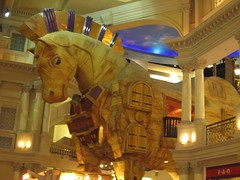
The FAO Schwartz Trojan Horse originally uploaded by Don't Wake Me, I Plan On Sleeping In.

For the past three Surfaces, I've made it a habit to pop into FAO Schwartz at The Forum Shops in Las Vegas.

I'm deliberate and specific in my shopping objective: one outfit for my daughter's Madame Alexander doll.

Now, before even entering the store, I have issues with FAO Schwartz and this doll... which my daughter received at a birthday party that took place at FAO Schwartz in NYC [don't ask; it's a whole other story]. Imagine a hand-size version of American Girl Doll where you pick skin, hair and eye colors. She came with a sad-looking pink stretchy shift [that I subsequently jazzed up].

I have a soft spot for dolls [vs. baby dolls] and hate to think of them not being loved and played with by a child. Going from experience, I know that the chance of a doll being ignored increases dramatically if she has no clothes.

So, I did my duty at the party and purchased one additional outfit -- trying to overcome sticker shock. I assumed that I could easily purchase other outfits for special occasions online.

When I got home and started researching, I learned that not only could I not purchase outfits online, but that my options consisted of shlepping into NYC -- or another FAO location -- or calling a personal shopper and wading through verbal descriptions of what the choices consisted of.

Can you imagine? Can you believe how inefficient and inconvenient a proposition? In this day and age? I was stunned.

But the poor doll needed clothes. And although I made her some, she still needed shoes and a few other items and with Surfaces in Las Vegas and FAO Schwartz there, too, well I had a less inconvenient option to consider.

If you've been to the FAO Schwartz at The Forum Shops, it's an imposing visual experience complete with Trojan Horse, larger than life stuffed animals and a vertical cornucopia of toy possibilities. Should be fun, right?

I take the main escalator which takes me to the top floor - one floor too high. So the store flow has forced me to an indirect path to my destination [I forgot to mention, I am tired from standing all day, my feet hurt, my back is sore and FAO Schwartz is as far removed from the entrance to the Forum as is physically possible]. I find the escalator to the mid level and locate the Madame Alexander section. It is poorly kept with broken or incomplete displays. No one occupying the register area there. The outfit I opt for is out of reach [I am average in height - i.e., what I encountered most shoppers would]. I must use another item to wriggle it off its post.

Did I mention that the entire store felt abandoned? Few customers, not a single kid. Not many sales associates.

I went in search of a manned register to pay. Found it and left.

Fast forward to 2008. Essentially the same experience. Same sad vibe. The interior of the store hasn't been updated, rearranged, changed in any way. As for Madame Alexander's outfits, they are exactly the same, except that they've been marked up an additional $5.

Oh, and when I checked out, I had to work to get one of the four sales associates to pay attention to me, they were so busy chit-chatting.

Needless to say, what few warm and fuzzies I felt for FAO Schwartz are gone. Not only do they force me to behave in a way that is inconvenient and inefficient for me - the customer, but they make very little effort to encourage me to return to their store: they aren't updating their merchandise frequently and their customer service attitude is indifferent.

FAO Schwartz breaks every rule that Paco Underhill details in Why We Buy: The Science Of Shopping. And with each visit, they charge me more for the same. Hard to believe that that's what a luxury retail experience is all about...
Technorati Tags: Del.icio.us Tags:

Thursday, August 16, 2007

Trying Ideas On For Size

Mix match originally uploaded by rebbcat.
"There are more sales lost in the dressing room than perhaps in any other place in the context of the store." So writes Teresa Méndez from The Christian Science Monitor in High-tech dressing rooms become virtual reality. New technology should make it possible for customers to solicit opinions from friends remotely as she quotes Paco Underhill. "It's a retail space where, on average, a shopper spends 3.5 very important minutes."

The article goes on to describe high tech developments to reinvent the "lowly fitting room" via a 'social retailing mirror.'

The notion of fitting rooms intrigues me. I've certainly noticed more seating outside of fitting rooms to accommodate those waiting - for example, Macy's with curved benches, and Urban Outfitters with living room settings. And, although Forthe & Towne has shut down [see Gap to close Forthe & Towne from 2/26/2007], I love what they tried to accomplish with their dressing room statement.

Dresser's Oasis from BusinessWeek Online Sept. 2005 explains visually how "Fitting rooms are the venue for the actualization of a woman's personal taste and style. Forth & Towne makes them fabulous." This 9/20/2005 BusinessWeek Online article by Andrew Blum explains it further in Forth & Towne: The Store's the Thing At Gap's new women's apparel chain, architectural design -- notably the dressing room's central placement -- is defining what the new brand is. This is where "the real stage is the fitting rooms" with the store literally designed around them. In VisualStore on Forthe & Towne -- "New concept offers a shopping sanctuary for the fashionably mature woman" from 12/5/2005, Anne DiNardo, Associate Editor, further describes the store concept with wonderful dressing room photos.

Even though the store is no more, I want to dwell on the dressing room.

NRF Stores states in Give Customers Some Space by Lorrie Grant from April 2007 that "Fitting Rooms are fast becoming inviting spaces with large changing and waiting areas furnished with plump sofas, fresh-cut flowers, art and entertainment. It's all part of a big effort to connect emotionally with the customer and increase loyalty and sales."

And, although Target perhaps doesn't represent the extreme of what Grant describes, The Curious Shopper asks How does my butt look? in appreciation for "what no average residence contains. That infinitely wise, truth-bearing, all-knowing and all-illuminating butt mirror."

Pshaw, you say! What does all this have to do with flooring stores?

In my humble target-woman-consumer opinion, I suggest that dressing or fitting rooms have a lot to do with flooring stores. Not in the sense that flooring stores should get into the apparel business. However, definitely in terms of offering consumers the equivalent of an apparel store fitting room: a place that encourages the consumer to try product on.

This is particularly relevant for ideas, concepts and products that have little to do with commodity transactions, that have everything to do with fashion!

A fitting room, dressing room, changing room - all represent names for a place where a consumer can comfortably consider different product ideas and try them on for size. If the idea fits, the consumer buys it.

Isn't that what we want consumers to do in a flooring store? We want to encourage them to consider possibilities, to try flooring ideas on as a solution to what they want to achieve in their homes. We don't want them to simply walk in and purchase the lowest cost whatever and never return...

Stores that understand have created dedicated areas where consumers can try on ideas, spread out fabrics, match up paint swatches with carpet samples and other flooring options. We aren't talking high tech here. It's a simple concept: at the very least a table and several chairs. Warm lighting would be helpful, perhaps even a board for pinning ideas up on. And, then, assuming your consumers engage fully with your retail experience [after all that is what you have created], they actually choose to linger in your store.... You might offer them coffee or water, and any other of the tools of hospitality that reassure them that they are welcome.

Are you convinced? Go on. Encourage your shoppers to try your ideas on for size. You may actually generate relationships and sales.

Technorati Tags: , , , , , ,

Monday, January 08, 2007

Engaging The Consumer... Via Store Windows!

Bergdorf Goodman Christmas Displays 2006 originally uploaded by James @ mannequindisplay.com.
I've always been an admirer of beautiful store windows -- probably comes from absorbing Parisian store fronts as a child as well as my NYC Bloomingdale days -- and I found it a real treat to listen to Linda Fargo, SVP, Fashion Director and Store Store Presentation, Bergdorf Goodman on 12/6/2006.

Linda is also the author of Dreams Through the Glass: Windows from Bergdorf Goodman. No surprise, her presentation was titled "Dreams Through The Glass" and TREX described it as follows: A store window offers a glimpse into the personality of the store itself. The message it communicates can, at best, evolve the store brand or, at worst, ruin the excitement of shoppers' first-impression expectations.

Dreams, romance, and lasting impressions can be possible through window displays. Join legendary visual designer Linda Fargo, who has achieved brand-evolving reality through fantasy merchandising, as she shows you how. Let her take you to the heart of a store through the eyes of its windows. This session will inspire and motivate you as you plan your own window displays.

Linda Fargo started her presentation by quoting Tom Bebe, former visual director for Paul Stuart: "Work like you don't need money. Love like you've never been hurt. Dance like no one's watching." What a neat way to capture the essence of passion and delight in what one does! Linda's background: she has been a part of the visual display world for 20 years via the Gap, I. Magnin, and -- for the last 10 years -- Bergdorf Goodman. In that time, she has created approximately 3000 windows [and numerous in-store displays and renovations]. Bergdorf represents 5 streets of windows, that are changed every 2 to 3 weeks. [Remember Paco Underhill's comments about windows? 'Tis the Season to Cite Paco: "A store window needs to communicate beyond the people immediately in front of it. Windows should have one message, not 15. They need to change no less than every two weeks to get people coming back. People should look forward to window displays as a place to have fun."]

Early on, Fargo challenged assumptions around windows - that only 1 designer should be featured at a time; that they be sedate and pretty. She wanted to play with the fantastic closet available to her and mix designers.

She likes to think through a multitude of little details to illustrate who the person in the window is, what her life is about, including -for example- a 1 way bus ticket. Or, in a hurricane window with Halston by Randolph Duke, she included newspaper articles about 'fair weather' ahead.

Her themes are about fairytale and fiction. Innovation and contradiction. Fashion, nature, unpredictable patterns. They are always tasteful, but may include trompe l'oeuil or contradictory effects. For example, a mannequin whose hand reaches through the glass [other part of hand is attached outside of the window!]. Beautiful, elegant, but not too serious. The windows are layered with many levels of meaning; many of the details operate at several levels, engaging the viewer's curiosity. The example she referred to here was the 'millennium' window that captured a sense of time travel and featured 1000 years of cultural clutter.

Fargo draws inspiration from many art sources Jackson Pollock, Fragonard, Antoine Watteau, Flemish Painters, Frida Kahlo and the startling quality of Surrealism. One example featured a woman with handbags all draped along an impossibly loooooong arm. Another used 1000s of pieces of toast....

But, these windows are also about show biz, street level theatre, striving to become evocative; definitely inventive windows and mixing the familiar with the strange to create a dreamlike effect. They are absolutely about emotion! And - as such - affect the customer experience! These are absolutely part of the store and brand experience and must be coordinated with adjacencies, changing rooms, and product selection! They create energy and embody vitality. [Remember what Lisa Contreras from Mancini-Duffy described in Bloomingdales Bathroom Makeover about customer experience and brand identity?]

The windows of a store capture the spirit and image of the store. They create an identity and present that identity to the consumer in such a way as to benefit the brand, and engage the consumer with the brand.

This 1997 interview with Linda Fargo from http://www.lookonline.com by Laurie Schechter captures a lot of Fargo's magic and includes some nice pictures. Do check out the images in this 1998 Holiday Windows presentation. It includes many of Fargo's Bergdorf Goodman windows as well as those from a few other New York City stores. [Also check out the additional Flickr images by James @ mannequindisplay.com.]

If there's a lesson from Linda Fargo's "Dreams Through the Glass", it is to take your store windows very seriously! Not in the sense that they should be formal and proper and boring, or totally obscured with promotional sales signs, but rather that they should celebrate all of the passion that you have for your store - especially your flooring and carpet store - and all of the passion you have for your consumer. Go ahead and engage her via your store windows!

Technorati Tags: , , , ,

Wednesday, December 20, 2006

Paco Sightings... and Rubber Soled Shoes

Well, not only 'Tis the Season to Cite Paco, but 'tis also the season to share sightings.

I sighted Paco Underhill earlier this year at the Science of Shopping Conference that Envirosell put on. I even shook his hand! Here's what he had to say about the current state of retail:

+ Retail innovation is happening in those places with a young affluent population base [e.g., Moscow, Dublin, Sao Paolo, Mexico City, Shanghai, Mumbai, Seoul...]. It is not happening in the US where our retail culture is overly focused on stock price rather than on what happens on the floor [or 'ground']. We are overly focused on the short term and getting results from opening new doors rather than from same store growth. We are overstored and for the most part reluctant to shed underperforming properties. Mergers [e.g., Kmart/Sears and Federated/Mays] have nothing to do with customers, and muddy the waters around the actual needs of consumers.

+ Design alone is NOT the answer. The fastest growing retail channel today consists of "anti-design" stores [e.g., dollar stores, Aldi, ...].

+ Category management perfects the status quo, and prevents category reinvention. So many aisles are at risk of gravitating to another form of distribution [e.g., the center sections of grocery stores are showing 5% loss per year. Where is it going?] and this isn't being addressed. What about new approaches to distribution? [E.g., What if you purchased a detergent plan when you bought your washer/dryer, and never had to go to a grocery store ever again for detergent?].

+ Consumers are time-poor and not willing to spend more time to accommodate larger formats. Interestingly, consumers routinely over inflate by 50% their reported time in-store vs. their actual time! Their perception of time spent is greater than reality and the ease of getting in/out matters to the overall retail experience.

+ As the 'first world', we face the following retail challenge: shopping cart use is declining as shopping missions change; for mass stores, 10-15% of customers are walking out with nothing; deep discounting is on the rise; and too often, the seminal object on the shopping list is NOT there, and consumers wind up making a decision to take EVERYTHING on the list elsewhere.

+ Failing Gender model: we live in a world owned/designed by men and expect women to participate in it. We must make our stores more woman friendly!

+ The service model is changing from one that has been nose to nose [i.e., across a counter] to hip to hip [i.e., next to one another] . This is the Sephora model [Starwood has implemented this, as well as some banks [e.g., WaMu].

+ Technology in-store: make sure it is bullet proof! The only 2 winners to date have been ATM machines and self check-in at airports. Technology that doesn't work in-store is worse than no technology at all.

+ Our relationship to consumption has changed: our symbols of success are in transition. It's no longer about gold, silver and stones which over history represented transportable wealth, particularly in times of war. What is indulgence and what is necessity?

+ It's vital to re-think the labor model, market by market. We live in a shrinking world and need to balance global vs. local identities. Shopping has strong social ramifications: people matter to the overall retail experience and if you and your staff have fun, customers probably will, too!

+ A fundamental shift is taking place with landlords becoming place makers. It's not longer just about real estate and collecting money, but also about programming good public spaces, etc., to encourage people to visit the space and interact in it and with it.

Given all of this, we must recognize that the realities of the setting [e.g., where is the real entrance? where does the experience start?] drive strategy. Amenability and profitability are inextricably linked, and operations, product, design and marketing must work together. That will drive successful innovation at the point of sale. Be sure to wear rubber soled shoes. That way you can think standing up and have a strong connection to the floor [or ground] to understand what is really happening.

Some other thoughts:
+ Windows are powerful: they both attract and repel! [e.g., Victoria's Secret] Make sure your windows create the effect you desire.
+ Aisles: respect body bubbles. Leave sufficient space.
+ Use language appropriate to customers rather than industry jargon.
+ For end caps and displays: sightlines and access are critical to success.
+ Our visual language is evolving faster than both written and spoken words. How we communicate messages is critical. We also need to understand how eyes work and age.

Paco showed us many examples of retail innovation from around the world, including Zara [see What Makes A Destination?]. Four of his other examples -- Roppongi Hills/Tokyo [which sounds a lot like a lifestyle center [see An Architect's View of Better Lifestyle Centers], Sao Paolo's Higienopolis, Three Minute Happiness/Tokyo, and Ibn Battuta/Dubai -- you can read more about in Susan Abbott's sighting of Paco Underhill during the Qualitative Research Conference: Toronto - October 2006.

One last reference from the 6/23/2006 issue of AIArchitect: an article by Russell Boniface titled I Spy A Shopper!. Not only does it feature numerous Paco pictures, but it also recaptures many of the points made in these last two Paco postings - including rubber soled shoes!

Paco refers to shoes to encourage us all to spend time observing firsthand what our consumers do and what they go through when interacting with our retail experiences. After all, how else than by Walking In Her Shoes can we ever create an environment that is more friendly to women?

Technorati Tags: , ,
Related Posts Plugin for WordPress, Blogger...