Flooring The Consumer on Simple Marketing Now

Please visit Flooring The Consumer's new home on SimpleMarketingNow.com where you can subscribe to receive updates to blog articles in real time!

Wednesday, February 28, 2007

Marketing To Women

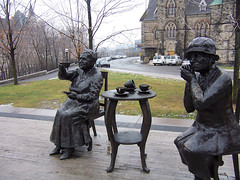
Grande Dames on Parliment Hill originally uploaded by I Eat Clay.

Five Reasons Why I Blog reminded me that I was quite remiss in not capturing here several other articles relating to Flooring The Consumer...

Below, you will find the 2005 interview for
Floor Covering Weekly Online [registration nec.] that formally got me going on the subject of marketing to women and the retail experience in flooring. It eventually led to contributing articles to Floor Covering Weekly.

Issue Date: 6/20-6/27/05, Posted On: 6/20/2005

Christine Whittemore on Marketing to Women
by Kimberly Gavin kimgavin@aol.com

Decades of studies have proved that women make the flooring purchase decision. To help retailers of Wear-Dated carpet capitalize on this, Solutia has a director of In-Store Innovation for Wear-Dated. Christine Whittemore, who holds the post, says retailers should cater to women for one reason: “It’s a business thing.” FCW Editor Kim Gavin spoke with Whittemore about the whys and hows of marketing to women. A more in-depth version of this interview will appear in an upcoming issue of FCW.

Why should retailers market to women?
Women represent 51 percent of the population and 47 percent of the labor force. Women hold 50 percent of managerial positions. There are more women graduating from college and graduate programs than are men. They represent 47 percent of Americans with assets over half a million dollars. The long and the short of it is that women are a significant force in the marketplace.

They are the chief decision makers on a whole bunch of fronts. Relating to the home: 40 percent of home improvement projects and products; 61 percent of major home fix-up projects; 83 percent of consumer purchases – and I’ve seen that go as high as 85; 91 percent of home sales. There are more single women purchasing homes; and about 94 percent make the decisions on home furnishings. Retailers who don’t make an effort to address that core consumer are going to lose business.

What do women want from a retailer?
Flooring is complex and represents big dollars. It’s not going to be a snap decision. She wants a place where she can relax, a store that draws her in to browse and touch. If she’s accompanied by a spouse, is there a space for the spouse to be comfortable? If she has children, is there a place where they can play? Women are developing higher expectations of the retail experience because there are more places now that are fun to go to. I forgot to mention that the bathroom had better be clean.

Consumers tend to consider flooring a commodity item because it’s so unpleasant to shop for. There’s no emotion connected to it. It’s been reduced to the lowest common denominator and that’s price. Consumers will trade up where product makes them feel good. Where it doesn’t matter, they are going to go as cheap as they can. Flooring retailers are missing a real opportunity there.

What are some of the more successful marketing strategies that you’ve come across?
Events where a consumer can come in. Maybe it’s a bring-a-friend event to hear someone talk in a store environment. Those are successful because she has a reason to go into a non-threatening environment. I can’t stress enough: No hard sell.

What are some other key points about the process?
Give her information. Make sure everyone (in your store) understands it’s a fashion item and it’s about making her home better. Visually, it’s important to show the product in a situation she can relate to. Show people living on the product.

What are the big marketing mistakes?
A big one goes back to respect. If you don’t respect her or take her seriously she’s going to walk out. Use signage and material so she can get educated. Don’t be a car sales person. Don’t prejudge. Don’t focus just on product features and benefits. Her eyes will glaze over. How will it help her achieve what she wants? Store environment. Don’t have one that overwhelms with racks and racks. How about giving her information with all those racks? It goes to the environment that draws her in. She’ll spend time. The more time she spends, the more comfortable she’ll be and the more likely she’ll be to spend money.

Technorati Tags: , , , ,

Monday, February 26, 2007

Five Reasons Why I Blog

Hat tip to Sandy Renshaw at Purplewren and Try Montage-a-google for a Neat Visual Experience for this "C.B. Whittemore Montage".

Robyn McMaster from Brain Based Biz tagged me in the blogosphere's most recent meme: sharing five reasons why one blogs.

As with Tag... I'm It!, many bloggers I respect have participated including Converstations's Mike Sansone in Why Do We Blog?, SuccessCREEations's Chris Cree in 5 Reasons Why I Blog, and Conversation Agent 's Valeria Maltoni in Connecting Ideas.

And, as with the Tag... I'm It! meme, it's fascinating to learn more about individual bloggers and what leads them to blog...

Here are my reasons:

Urgency - how to get ideas about the importance of marketing to women, focusing on consumers and improving the retail experience [especially in flooring!] out to others faster than traditional tools allow? I contribute to Floor Covering Weekly [e.g., How To Achieve An Inspired Environment], but there's a significant lag between submission and publication. Not with a blog!

Practicality - where to store and organize ideas [about marketing to women and the retail experience] so I can easily find them and refer others to them? In a blog, by Jove!

Curiosity - how to participate in this new non-traditional marketing world [a.k.a. web 2.0] that so many outside of the blogosphere don't yet understand or readily dismiss as a fad, but that my gut tells me is critical to the future? With a blog, of course!

What I have discovered in the process [beside learning html, and all about rankings, site stats, links, Flickr, YouTube, ....]:

Through blogging, I can unabashedly share my passion in the most interactive, vibrant, alive and welcoming environment ever. It makes college and business school pale in comparison. By blogging, I have met more like-minded people who teach me more than I ever thought possible. Ideas once disconnected now flow together with the promise of greater enlightenment, truly worth more than the sum of any parts.

Thank you, Robyn!

In turn, I tag:

+ Laurence-Helene at Blog Till You Drop.
+ Derrick Daye at Branding Strategy Insider.
+ Maria Palma at Customers Are Always.
+ Susan Abbott at Customer Experience Crossroads.
+ Todd And at Todd And's Power To Connect.

Technorati Tags: , , , , ,

Saturday, February 24, 2007

Lis Calandrino - Tips From the Trade

Resource Scheduler and Resource Task Quantizer originally uploaded by David Seah [also check out David's websitewhere he explains his scheduler/quantizer in greater detail].

Lisbeth Calandrino - whom you may remember from an early post titled What Consumers Really Think detailing consumer research she and Sonna Calandrino conducted - moderated a panel discussion during Surfaces 2007 on "Strategies for a Successful Retailer." Participating were Tom Jennings from Bud Jennings Carpet One, Olga Robertson from FCA Network and Tom Boschwitz from Home Value/Drexel Interiors.

Lis Calandrino, very involved with Sonna on Fabulous Floors Magazine, also contributes to Floor Focus Magazine, and has an amazing training and presenting reputation in the industry. Not only has she created powerful training programs, but she also has to be the most dynamic and engaging speaker I've encountered in a long time. Unfortunately, I missed her presentation titled "Building Your Competitive Advantage" [conflicted with my session!], but got a taste for her ability to draw in the audience while showcasing the uniqueness of her panelists in this session.

Tom Jennings went first. He is President, Bud Jennings Carpet One in Lawrence, Kansas. It's a 47 year old company, with one 5000 square foot store that generates $4m in business. Pretty impressive. Tom has also just sold the business and will be managing installation training at CCA Global.

Read this Floor Focus Best Practices article [by Lis Calandrino!] about Bud Jennings Carpet One and you'll understand how extraordinary this business is. Note that Tom has a predominantly female sales staff; installation is an integral part of the business [not an afterthought]. Pay attention to how he promotes his company [i.e., Bud Bugs], and how important he considers DETAILS [which women notice] and the messages that these DETAILS communicate. This is a company that takes the customer very seriously!

Tom Jennings focused on how critical it is to connect the front end of the store [i.e., sales] to the back end [i.e., installation]. I found this profound given my Mom's experience [see My Mom Is In The Market For Carpet, Next Issue: Dizzying Choices, and Final Issue: Endless Frustrations].

Some of his points: communication is critical; the best installer isn't necessarily the best with the customer. Expect good results and you will get good results. Reward positive behavior... Lots of sound management advice here!

He addressed the sales to installer relationship as well as the installer to sales relationship. No surprise, there were many overlaps. Nonetheless, I haven't often heard about such planned integration between the many steps in the flooring sales/installation process to successfully delight the consumer!

For sales: communicate constantly because no one likes surprises. Be sure to affirm the skills and abilities of the installers [i.e., know their names!]. Know what installers can and cannot do so the salesperson can prepare the customer. Remember that what the installer does today affects the future [i.e., repeat purchases, referrals]. Be flexible. Try to solve problems rather than blame others. Be a team player. Be excellent at passing the baton. Don't express opinions if you don't know enough. Don't give the customer the impression that you are handing them off. Reward positive behavior and don't forget the support behind the work.

For installers: communicate constantly. Affirm the abilities of sales and management. Remember that sales today affect the installer today. Be a team player. Don't point fingers. From a training perspective, it's critical to teach installers how to approach a customer's front door; how to deal with the first 10 minutes of a customer visit. For example, arrive with only a clipboard, not with multiple bags of tools and supplies. Discuss expectations first, listen, confirm that where you have parked won't interfere with the consumer. The analogy he used was visiting a surgeon for the first time - do you meet a person in regular clothes or one in scrubs with scalpel in hand ready to make incisions on you at that instant?

Jennings requires that his staff call ahead to say that they will be on time! What a concept!

Next, came Olga Robertson, President FCA Network, an exclusive buying group for 60 independent specialty flooring retailers around the US, including the affiliated FCA Inc. stores, which she joined in 1978. FCA has 6 full service locations in the Chicago area generating $40m in floor covering sales. Olga started FCA Network in 1998, and has grown the network to $70m in professional installations.

She was recently named one of the 20 most influential women in the flooring industry by Floor Covering News as described in Flooring Group Honors Local Woman.

Robertson discussed the changing dynamics on the sales floor and how that affects the consumer. Indeed, the biggest change is that the internet -rather than a salesperson- is what influences a consumer's choices in floor covering. She still expects service and good value and will still buy from people she likes and trusts, but she is predisposed to buy a certain product as a result of what she sees/experiences online.

This means that salespeople training must take place on an ongoing basis and at least weekly! For many retailers, this creates a burden as many don't know how to train, or prefer not to because they either don't know how or don't like to train. Retailers have plenty of options available: they can bring in experts like Sam Allman to teach courses like the Secrets of Peak Performing Salespeople. Take advantage, too, of the training that manufacturer representatives can offer.

Robertson urges retailers to work closely with manufacturer reps to ensure that the training follows specific guidelines [20 minute timeframe, be sure to address topics such as features and benefits of products, installations dos and don'ts, what's in it for the consumer.....].

That is the only way to differentiate oneself from the Big Box retailers.

Last, but not least, was Tom Boschwitz, COO, Home Valu Interiors, headquartered in Minneapolis, MN. Started in 1963 by his Dad, this family business company originally sold mostly plywood and paneling. Home Valu has 9 locations, offering full service flooring and interiors [i.e., rug, windows, kitchen, bath...] and generates approx. $125M in sales. It is run by the 4 Boschwitz brothers.

Tom focused on the criticality of Listening to Customers and using that as shock treatment for salespeople to get them focused on adapting to a changing customer environment.

He provided some background: Home Valu is an established business. It does a lot of TV advertising, has a large sales team many of whom are veterans; its core customer base is ageing. In other words, it had not adapted to changing times.

Indeed, when Home Valu examined its business, it realized that no salesperson was selling over $100k! No one was maximizing referrals or generating significant repeat business. Referrals were taking place, and were important, but they weren't happening on a planned basis.

The paradigm that Home Valu faced was how to change?

Fortuitously, a major market shift took place in the Twin Cities with Dayton's Marshall Field's stores being renamed Macy's. Marshall Field's had been the biggest flooring store in the area and the biggest Karastan store in country. What a moment of opportunity for Home Valu who eagerly took on that Karastan role!

Home Valu decided to start listening to customers, and to use that information as "shock treatment" for its salespeople. For 6 to 8 months, the company spoke with customers focusing on approximately 12 who had visited but not purchased from Home Valu and got phenomenal information. Boschwitz shared one specific example about an African American woman who said that she couldn't get help in his store. She bought instead from ColorTile, primarily because ColorTile called her to say Thank You For Coming Into Our Store! Perhaps a small thing, but what a powerful one.

With this preliminary round of consumer feedback, Home Valu has held a one day training with its salespeople looking at the common elements in the stories heard from consumers. The most critical one was following-up with the consumer. Salespeople are now being more programmatic about followup and sales numbers and profit margins have improved dramatically. Everyone is happier and more engaged.

Tom is preparing for another training session, focusing this time of feedback from approximately 25 customers who love Home Valu. The message this group has sent is to be easier to do business with. Home Valu has also used this customer feedback to change its advertising and marketing to be more relevant.

By listening to your customer, you can gain invaluable insight that -if acted upon- will not only lead to greater loyalty and referrals, but also to increased profitability, and a more engaged employee base.

These 3 retailers reinforce that success comes from paying attention to a multitude of details that affect the consumer. If you listen to her, you can find out what matters to her. If you integrate the various segments of your business in a cooperative, supporting relationship, you can anticipate issues, resolve them or avoid them altogether to delight your consumer. If you constantly train your organization, you will always be at the forefront of new developments and better able to anticipate change. The end result will be repeat business, more referrals and greater profitability. Sounds worth it to me. What do you think?

Technorati Tags: , , , , , ,

Sunday, February 18, 2007

Banish the Hard Sell - Focus on Value, Not Price!

Carpets originally uploaded by bdoubleu.
The flooring industry - as do many industries - struggles with selling VALUE. A frequent approach is to go right for the jugular and immediately push a low-priced product. Barely has a customer set foot through the door that she hears "Have we got a great deal for you! Let me show you. You can't get it for less anywhere else!"

Sound familiar? Doesn't it make you feel all warm and fuzzy? You start relaxing because you know that someone has YOUR best interests at heart, right? There's no way you'll wind up with a lemon, right?

WRONG! You know that the dreaded HARD SELL is upon you. You steel yourself for an antagonistic and hostile transaction. You get tense, suspicious, and prepare yourself to run out the door at the earliest opportunity. And, you count your fingers before leaving the store - just in case someone got away with something while you were watching...

Imagine if it were different... You are greeted respectfully and courteously, made to feel at home... You are asked about your project, your dreams, your ideas. A serious attempt is made to understand you and figure out how to bring you meaning and value via product recommendations. Wouldn't that be fantastic?

Many of the flooring trade shows and conventions attempt to address that very issue and Surfaces was no exception [e.g., Why Amazing Shopping Experiences Matter]. Given that the hard sell tops the list in creating a really negative shopping experience [think used car sales], flooring stores able to get away from price, from commodity and from hard sell stand to gain the eternal gratitude of women consumers around the country! And eternal gratitude means repeat purchases and strong referrals -- all of which lead to increased profitability! Ironically, banishing the hard sell to focus on value rather than price remains a really hard sell for most flooring retail sales associates.

Warren Tyler - another Surfaces presenter - offered the following advice in his presentation titled Selling Value - Not Price:

Successful retailing is about uniqueness. What is it about your flooring retail store [and brand] that is truly different from the competition? What is it that you offer consumers that enables you to sell at a higher profit margin? If you have nothing unique, then you can only sell based on price - not an easy game to win! [See The Water Droplet Girls with a most appropriate quote by Patrick Hanlon, author of Primal Branding: Create Zealots for Your Brand, Your Company, and Your Future.]

Never forget that flooring represents a fashion solution to create a beautiful home for the consumer. If you can help her put together a beautiful home, you are offering her value. If you can offer her value, then price is a non-issue.

If you cannot, then price will be the main issue. And, if she shops price, she neither likes you nor trusts you. [Say goodbye, then, to repeat purchases and referrals!]

Surround yourself with sales associates whose passion for home furnishings and creating a beautiful home is contagious! And keep their knowledge fresh by exposing them to ideas! Either through the home furnishings trade press, through manufacturer and supplier trainings, by visiting creative homes, via the internet even reading design books bookstores or the library. Consider inviting local design schools to send their students in to do projects for credit, or having local designers do the store windows.

[By the way, here are the Color & Fashion Links from the sidebar of Flooring The Consumer: Color Marketing Group, Iconoculture, Living In The Box, Michelle Lamb: Connecting the Dots, Sensational Color, spheretrending.com, The Cool Hunter - News, The London Trend Report, The Runway Scoop, trendwatching.com , World Trend Events from trendwatching.com in case you need some ideas.]

Always change the vignettes, and the windows! The windows are the soul of the store [read about Linda Fargo's windows in Engaging the Consumer... Via Store Windows]; they are there to entice the consumer. This is a FASHION business, and unfortunately, the most common floor covering window decoration is the back of a carpet rack. Yuck! What message does that send your consumer? [One flooring store by me has had a "Grand Opening" sign for the past 2 years. The lighted Rudolph stays in the window all year round; luckily the lights aren't turned on until November.]

Remove fluorescent lighting. It's ugly. Not only does the product look ugly, but the consumer does, too! Use incandescent lighting instead.

Tyler bemoans the excessive choice of beige as a carpet color. "Beige does not a WOW factor create! How can anyone sell a home without a WOW factor? Never sell a plain room. You will lose your consumer and all of her friends."

Selling a WOW factor requires a sense of design. It requires passion for the consumer and what you can help her create. The benefits are enormous:
- it discourages comparison shopping
- it separates you from your competition
- it inhibits price shopping

More importantly:
- it generates many more referrals [new customers who refer even more customers]
- it inspires customer loyalty [and a relationship filled with a multitude of transactions]
- it puts your salesperson in control
- it establishes your store as a decorating source
- it leads to higher sales and greater profits and commissions.

Remember that product and price are the least important items in a store IF you can develop a relationship with your consumer and understand better what she is trying to achieve. Then, help her achieve that vision and you will be offering her absolutely priceless value!

[For the history behind -or under- Don Bailey Carpets, pictured above, see He bared it all to cover floors in the 5/15/2004 issue of The Miami Herald by Nicholas Spangler. It's a good story.]

Technorati Tags: , , , , ,

Tuesday, February 13, 2007

Pounding Las Vegas Pavements

Welcome to Fabulous Las Vegas Neon Sign originally uploaded by Neato Coolville.

Back from Vegas, with a stop in Dallas, and my feet are so grateful for some R&R. As are my knees... my back... my whole body!

I noticed something funny: what I pay attention to changes depending on which part of my body speaks and with which tone of voice.

Trade shows, especially in Las Vegas, make walking 60 or 80 NYC blocks seem like a leisurely stroll through Central Park. My first day, I delighted in the balmy air [vs. 8 degrees in NJ], the preposterous global/historical architectural reincarnations [where else but in Las Vegas can you gaze upon the Great Pyramid, the Eiffel Tower, the Canals of Venice and the Empire State Building all in one day?], and the upcoming nighttime neon display.

A long 24, 48, 72 hours later, walking back and forth through endless fields of chiming, flashing, clanging slot machines seemingly pulsating to rhythmic, primal music, my body became more inward focused..... I trudged on magnificent marble floors to get to and from our booth in the convention hall. My senses became increasingly focused on finding 'safe' zones - with subdued sounds and carpeting underfoot. I played games with myself: could I make it from one escalator to our booth through the casino floor without leaving carpet?

Our booth represented an oasis, carpeted as it was with scrumptiously dense carpet [CustomWeave's Rosewood and Horizon's Stylin' by Mohawk] made with Wear-Dated carpet fiber [naturally!] and deliciously buoyant pad. It transfused energy to my weary bones. Stepping off meant trusting energy sapping concrete. Ugh!

Las Vegas with its sumptuous display of hard surfaces [marble, granite, cobblestone reproductions at the Paris] and expansive casino floors [I wish I had worn a pedometer] led me to question [yes, selfishly, but there must be others like me out there!]: why isn't there more and denser CARPET being used in public spaces?

As gorgeous, elaborate and princely as these marble designs are, I'm always amazed at how hard they are on the user. Waiting in long lines to register or checkout from the hotel is agonizing [Vegas gives new meaning to long lines!]. Combine that with how sound reflects off of hard surfaces, and my ears were in agony, too. At least my full body was engaged!

I'm in no way suggesting that the entire world should be carpeted [although I'm willing to debate the matter], but isn't there room for more deliciously cushiony and forgiving carpet?

Look at this photo from Charmin's Pottypalooza
[for a thorough backgrounder on Pottypalooza, read Charmin Bathrooms in Times Square] back around the holidays. Notice the carpet. I stood on that carpet for a good 15 minutes. Let me tell you, it was densely padded. Charmin expected people to have to wait to use their loos, and created the most forgiving waiting environment ever using cushiony carpet, offering seating [for after-the-loo waiting] and plenty of entertainment [i.e., learn how to "Do the Dance!"].

Contrast that photo with these two from the Atlanta airport, concourse D. It used to be completely carpeted. Now, it's gorgeously glamorized, updated and redesigned with marble and granite floors. It is PAINFUL to trek these concourses [which go on forever].

On top of that consider how visually distracting these highly reflective surfaces are! Look at how the ceiling lights reflect off of the floors. Look at the columns: they continue on into the floor. People are reflected, too.

This is particularly distracting to fast and efficient airport walking. How to negotiate pedestrian traffic, walk on the right and pass on the left? With difficulty! The reflections misinform and detract from efficient and smooth manoeuvers. I lose focus with so many inconsistent messages [what looks like a person is simply a shadow].

[To illustrate my point, look at the difference between how differently the window reflects on the granite vs. the sitting area carpet.]

Ahhh. I feel much better having shared these thoughts [I'm also off my feet for the first time in 7 days]!

However, as you pound the pavement or walk around your home, office, or store, listen to the messages the flooring sends your body. Are they relaxing ones? Are they energizing ones? Or are they sources of aggravation and frustration? If so, can you moderate those to the benefit of your customers? Subject for thought, eh?

Nonetheless, it was a good trip to Las Vegas and Dallas. Why Amazing Shopping Experiences Matter was well received, with great participant feedback and comments. I'm honored that Kim Gavin -editor- and Ken Ryan -executive editor- from Floor Covering Weekly attended, too.

On top of that, Liz Calandrino from Fabulous Floors has offered to contribute perspectives to Flooring The Consumer. Very exciting!

And, in Dallas, I met John Simonson from Floor Facts! He, too, was doing a seminar. Check out these two posts -Knowing What Ingredients are in a Carpet and Flooring The Consumer- to his blog. Thanks, John!

It's great to be home!

Technorati Tags: , , , ,

Monday, February 05, 2007

Why Amazing Shopping Experiences Matter

Merry-go-round originally uploaded by Don Baird [picture from a merry-go-round in a shopping mall near Las Vegas].

I'm off this week to Surfaces 2007, the yearly floor covering trade show in Las Vegas, and don't expect to have many opportunities to blog while onsite.

Not that I won't be thinking and talking about everything that takes place here! Quite the opposite.

I'll be presenting "Why Amazing Shopping Experiences Matter" as part of the Surfaces Educational program.

The presentation mixes a little Paco Underhill with some Paradox of Choice [see The Problem With Too Many Choices and Are There Too Many Choices? ]. Then I add some marketing to women, some Trading Up, bring up Ageless Marketing and top it off with some case studies [Las Vegas is a good place for case studies!]. For added measure, I throw in a reference to Raymond R. Burke's 10 Principles of Retail Shoppability, and Pamela Danziger's new book Shopping: Why We Love It and How Retailers Can Create the Ultimate Customer Experience. Then, I mention the Bathroom Blogfest and quote both David Polinchock from Experience Manifesto as well as Patrick Hanlon [see Creation Stories].

Here's the official write-up from Floor Covering News in an article titled "Surfaces Educational Conference promises something for everyone".

Las Vegas—This year’s Surfaces Educational Conference once again promises to offer something for everyone. Over a four-day period, 42 sessions along five targeted tracks will be presented. Show officials said through these seminars and workshops, retailers, installers, architects, designers, distributors and builders can get information they need to succeed.

Friday, Feb. 9, 8 a.m. to 9:30 a.m.

Title: Why Amazing Shopping Experiences Matter

Track: Marketing


Retailers who are able to create amazing experiences are the ones that consumers will gravitate toward. Review demographic information, the latest trends affecting the marketplace, different gender approaches to the shopping process and reactions to the in-store environment.

Speaker: Christine Whittemore
[a.k.a. C.B.]

If you don't make it to Surfaces, but do attend the Mohawk ColorCenter show in Dallas, you can still experience Why Amazing Shopping Experiences Matter on Saturday 2/11/07 at 9:30am.

If you are at either show, I'd love to see you. At Surfaces, you can find me at the Wear-Dated Booth #4758.

Technorati Tags: , ,

Friday, February 02, 2007

A Retail Experience in Bariloche

Photos courtesy of Betsy Jackson.
Imagine beautiful, scenic Bariloche in the Argentine Patagonia region southwest of Buenos Aires. I had heard of Bariloche before in terms of its ski resorts that avid skiers [in this case Serbian ski instructor friends] describe with longing and desire. I have even sat through slide shows showing the resort, the runs, the hefty concrete pillars for the ski lifts and the amazing human construction feat.

So, when I received an email from Craig Jackson -- a Solutia Fellow [in my company, that's a big deal!], responsible for BCF Carpet Fiber Product Development -- referring to a retail experience in Bariloche, I took note.

Craig is based in Greenwood, SC, and works closely with Manufacturing, Technology, Marketing, and sometimes directly with carpet mills and the design community. He exudes passion for carpet, carpet fiber, Wear-Dated, and coming up with ways for consumers to benefit from carpet.

Craig's daughter, Betsy [thanks for the great photos!], is the reason that Craig and his wife, Louise, wandered down to Bariloche [and a few other areas down South]. As he describes:

"Last March 2006, my daughter finally decided that she could get away for a wedding in Santiago where she could meet up with friends from a hike to Machu Picchu. The wedding was then four weeks away. Out of the clear blue sky she said "mom, why don't you and dad come along?" We couldn't think of a good reason not to go, so we went. Purely a spur-of-the-moment lark - no planning, no anticipation. I listened to Spanish tapes while driving to and from work (ten minutes each way) and got some shots at the local clinic. "

Betsy clarifies things: "And just to give my parents a little more credit for being spontaneous, we actually decided to go 14 days prior to leaving for the trip to Argentina and Chile."

Interestingly, as did Reshma in Lost In The Supermarket, Craig reacted to the same point in Katia's A Transcultural Perspective on the Retail Experience post. More specifically: "I had visited the US a couple of times before I came to live here, and one of the things that struck me most was the enormous variety of products available on store shelves compared to Latin America."

This prompted him to retrieve the attached photos from a visit to a South American "big box store" akin to Lowe's and Home Depot in Bariloche. [To give you an idea of geography, go to Dacar Car Rental site; it has great maps.]

The store - a recently opened Hipertehuelche [read this article for more information about the grand opening in 12/2004] - is attractive and eye-catching, particularly with the interesting angle of the general entrance. That and the colors make for an interesting contrast to our big box stores.

I'm also struck by how neat and clean a first impression I have. Isn't it interesting that unlike our big boxes, we see no fence samples, and outdoor shed displays, and snow blowers and other products that our stores so often showcase outside the main entrance?

This other photo shows the contractor service entrance. It strongly states "construcciones" so no way a consumer can mistake that for the general entrance. Again, neat and uncluttered.

At this point, you may be wondering why Craig and his daughter dragged themselves to a home improvement store in what might be described as the most scenic spot on the planet, or at least in Argentina and Chile.

I asked him why he decided to enter this store.... Do you remember his passion? "I enjoy comparing carpet displays in foreign stores to our domestic stores." Cool! And his daughter happens to be a Marketing Manager for Lowe's. The passion runs in the family. Even cooler!

This next photo shows the general interior and main aisle which look neat, clean and well organized. I particularly like the peaked skylight roof, and can imagine the beautiful natural light that cascades through.... casting a warm glow on the products below. Pretty clever.

Now here is where we begin to experience some cultural differences in retailing.

This next picture captures a stove display. You see 2 of the 5 on display.

Notice that the stove hoods are on a shelf under the stoves.

In other words, the products aren't really displayed to make sense to the end user. Rather than being about consumer choices and preferences, these options look more to be about functional and utilitarian decisions [i.e., black/white and price point].

According to Craig, there was only one refrigerator, and it was covered with stretchwrap. Which to me says that it wasn't meant to be opened up, examined, and compared to another refrigerator.

In case you haven't caught on, the stoves and the fridge are a warm-up for what comes next: "the horror". Have you guessed what it is? The carpet section!

This next picture captures most of the carpet display section.

"Notice the rolls on the roll-rack: they display the rolls of carpet in a way that doesn't in any way show the pile [or the fuzzy part of the carpet]. Rather, they show either carpet backing or... craft paper wrapping."

Hmmm... I don't usually purchase carpet based on the backing. Should I? I always thought it was the nice, soft fuzzy stuff that I needed to pick.

Craig continues: "Notice the very neatly penned price tags on perfectly cut-out cardboard signs. The lettering is uniform and nicely visible from a distance. The red catches one's eye. Look carefully and you'll notice, though, that these price tags cover up most of the "big" carpet samples that consumers are supposed to base their decisions on." Another point: how can a consumer touch those samples and compare them without either being 10 feet tall or having extra long arms [think The Incredibles].

There's more!

"Notice on that middle pillar-like section a series of teeny weenie carpet color swatches glued to cardboard which, in turn, is glued to the metal framework of the carpet roll-rack. Half of the swatches are in a shadow. To look more closely, the consumer must move some tubs of unknown substance that sells for $131 pesos. Oh yeah, don't trip on the roll of wire!"

What an amazing journey as it relates to the consumer retail experience. I find it fascinating because, although in many cases we do a better job creating a retail experience that connects with consumers, we still have plenty of opportunity at home to do it better. Particularly as it relates to meeting the needs of our very important woman consumer! There's a great deal to be learned regardless of which country we are in.

Anyone ready to improve the carpet buying experience in Bariloche has a willing partner waiting in Craig Jackson. His passport is current!

Craig's Travel Review and Tips for this Trip:
"Santiago and Buenos Aires are both lovely cities and Bariloche is absolutely gorgeous. Go. Bring a bundle of American one dollar bills for tips. Getting there is expensive, but mitigated by the low cost of everything there. Excellent wine - $3 US. Long taxi ride with luggage - $35 US. Wonderful beef dinner - $10 US."

Thanks to Betsy's photos and to Craig's descriptions, I am finally able to pay homage to Stephanie Weaver from EXPERIENCEology who in every post does an outstanding job of bringing to life via photos a customer experience. If you haven't visited her site, do so. You will undoubtedly get ideas on how to improve your overall retail experience.

Technorati Tags: , , ,

Tuesday, January 30, 2007

Lost in the Supermarket

Day 21::Fishbowl originally uploaded by Meredith Farmer. The caption of the photo includes: "I'm all lost in the supermarket, I can no longer shop happily, I came in here for that special offer, A guaranteed personality"

Well, A Transcultural Perspective on the Retail Experience and Musings on Choice, Culture and The Retail Experience have hit a nerve.... One that carries universal relevance as we come across too many situations that offer often infinite choices. Some categories are worse than others: in this guest post, Reshma Anand from The Qualitative Research Blog uses the supermarket as the backdrop for her observations.

I first met Reshma through Bathroom Blogfest '06 and have developed a great respect for her ability to critically observe and then take a concept away from its paradigms to suggest a new approach. In this case: having the product FIND the consumer.

Reshma describes herself as a freelance qualitative researcher and hypnotherapist, serious about uncovering the truth behind motivations. Originally from India, she has lived in Wales (Cardiff), and Ireland (Kilkenny), and can currently be found in London. As she explains, "this kind of nomadic lifestyle has put me in a constant 'comparison mode'... And, being a qualitative researcher, I can't help but observe my own behaviour and whatever is happening around me. Trying to find patterns and connections has now become an habit."
----------------------------
Having grown up in a different country, it was natural to feel surprised, confused and sometimes shocked and even amused while getting acquainted with everyday products and brands in a new retail environment. The differences between home country (India) and the new locale (UK) were magnified in my mind which I attributed to the varying maturity of the two economies which has an obvious bearing on the retail environment. Until I read this post by ¡Hola! Oi! Hi! 's Katia (a Brazilian living in the US) who gives her transcultural marketing perspective on making everyday consumption choices and how those are influenced by her experiences in her home country. She goes to say….

Since I’ve been living in the US, I’ve gotten used to and enjoy the many choices the market offers, but I still shop pretty much the way I did back home: I simplify my life by opting not to choose and just pick what I really need or can afford.

Then there is Blog Til You Drop's Laurence (originally from France and now lives in the UK) who talks about finding French products on the shelves of British supermarkets and how sometimes too much choice can get in the way of making a purchase decision.

I realized after reading these accounts that the bewilderment I faced was not only on account of the obvious differences in the retail environments / retails formats (the dominant mode of retail in India until a couple of years ago was neighborhood grocers, the mom and pop store variety) or the scale of choice available in the home country. It was:

A) A function of being in a foreign environment – a factor that would affect me as much as it would affect any other outsider. Whether that outsider was from a developing retail market or a mature one was immaterial. As C.B. rightly points out that ‘foreign-ness can even occur at home’ &

B) A result of too much choice and having to navigate through the deluge to zero-in on the desired purchase.

As we acclimatize ourselves to a foreign market there are work-arounds we find sometimes consciously and may a times subconsciously. Triggers that aid the adoption of new products / brands can be cues for marketers aiming to win over a new audience.

The search for the right ingredient
Food choices and habits do not change easily and when in a new market people try to find ingredients close to the ones they used back home. Finding a perfect substitute is not always possible and easy. Once abroad, people experiment with local produce and exchange tips with friends on near perfect substitutes they discover. For instance, I don’t know what ricotta cheese or sour cream is locally used for, though I know some Indians abroad use a combination of the two to create a substitute for ‘sour yoghurt’ – yoghurt in India acquires a tartness that any diary product would in a warm climate. The stages before these perfect discoveries are most frustrating, since not always do we have friends handy to share such information.

Could we have the product find the consumer instead of the other way around?
I remember walking into a supermarket in Bangalore, India on one occasion and encountering an American food festival. The aisles sported American flags along with peanut butter jars, American corn, Oreo cookies and such like. Too conspicuous to be missed.

Supermarkets in the west have aisles dedicated to foreign foods. Imagine having an Indian or a French food festival in one of those aisles. It would not be difficult for a supermarket to track what local brands / products are being picked up by the Indians or French regularly. Overlay this information with what or how it is used. Placements of these products close to the foreign food aisles along with flyers that mention their adapted use in ethnic cuisines can do the trick (think ricotta in Indian cuisine).

Supermarkets already do this though right now I have only seen such efforts targeted at the native audience. Extending this to a foreign clientele cuts down the process of trail and error for the consumer while the marketer finds a new audience for his product.

Could price sensitivity be a barrier in adopting new products?
While conversing with a friend yesterday, I asked her how she made her choices and like most of us she moved from the known and familiar terrain, slowly into the new and unfamiliar. The transition into the new was often triggered by a price-off. I could relate to that experience. I am a non-experimental shopper by and large and my eyes stayed focused strictly on pre-decided products though one thing that never fails to catch my attention is when I see a ‘yellow price slip’ from the corner of my eye suggesting a price cut. Indians coming abroad are by and large price sensitive partly because they use the home currency to benchmark rates against, but prices-off are universally effective in initiating consumers to new brands. Since a price-off brings down the risk associated with experimentation.

These are just some of the work arounds. I am sure there are more and it would be interesting to hear and read about those.

The issue with adapting to a foreign environment is as true of consumers as it is with marketers entering a new market. The retail landscape in India is abuzz with activity as modern format retail outlets start to make their presence felt and some foreign players (e.g., Wal-Mart) emerging on the scene. In their quest to woo the elusive consumer some of these new generation grocery chains are taking lessons from the traditional retailers while the latter are morphing themselves to keep pace with the competition.

More on that next in The Qualitative Research Blog.
--------------------------
Although some may think that supermarket issues have little to do with other retail experiences, I disagree. Supermarkets represent extreme examples of what we encounter in retail environments... Do product presentations make sense to a consumer coming in with a 'foreign' [i.e., from outside of your industry or geography] perspective or are they as overwhelming as that of a supermarket? In a comment to Blog Til You Drop's post titled Too Much Noise, I mentioned how oblivious I am to many new products and brand extensions. They just don't connect. However, if I read about them in a business magazine [i.e., they are taken out of their competitive element], I begin to consider them and evaluate them as a source of new benefit to me. In one sense, through that business case write-up, the product finds me.

Technorati Tag: , , ,

Sunday, January 28, 2007

"Sorry pumpkin" - The LabCorp Saga Continues

The Ugliest Pumpkin originally uploaded by Yemenia.
If you remember from Hall of Shame Inductee: LabCorp, I had a not-so-good customer experience with my daughter right before the New Year.

Bruce Friedman at LabSoftNews picked up the story in Customer Criticises LabCorp for Bad Blood Drawing Experience.

Jan. 15th I received an email from Pamela Sherry, Senior Vice President Corporate Communications at LabCorp, saying "I saw the blog and the concerns it noted, and would very much like to check into the service at the LabCorp site you mentioned in the blog. Is it possible to forward to me the address of the site?"

I responded back with general information about the location [I was traveling], and heard nothing further.

Well, I guess someone checked into the service at that site because the next thing I know I receive the following anonymous comment:

"Sorry pumpkin, actually not supose to say first and last names. Hippa Violation! It's a cinch you don't know anything about what goes on behind those walls and you have total and complete tunnel vision, I would like to say I am sorry about your experience but since you make to attempt to understand what other people may be going through, I see no reason to give you any sympathy at all. By the way did I say whinner?"

Although taken aback at first, I'm grateful that this LabCorp employee took the time to comment. It gives me the opportunity to address his/her points and also touch on the bigger picture that LabCorp, in following up, either didn't get or didn't communicate effectively [to 'Sorry pumpkin'].

By the way, this LabCorp facility reminds me of how the NJ Department of Motor Vehicles used to operate: people would come in, take a number, and sit for 2 or 3 or 4 hours until their number was called [remember BeetleJuice?]. DMV employees were NOT nice about that either. There was a machinery at work that had nothing to do with the human beings it serviced. Now, I walk out of my local Motor Vehicles Office 7 minutes after walking in; everyone treats me professionally and respectfully and I have even been offered to have my picture retaken 3 times. How's that for service?

Getting back to my note from 'Sorry pumpkin' - my one reply from LabCorp. It indicates to me that LabCorp assumed they had an easy situation to fix: be nicer or do better. Most certainly not! It's an infrastructure problem, not a "tell your employees to be nicer to the customer" problem. Which clearly upset 'Sorry pumpkin'... when s/he was told that.

Let's start with waiting time. I experienced a 2 hour wait. The woman next to me, a regular, stated that 2 hours is the norm whenever she comes. A 2 hour wait is simply NOT acceptable, especially when a good number of the tests involve a patient producing their own specimen. I accept that it takes longer when the phlebotomist [thanks, Bruce!] must draw blood, but we're still talking minutes not hours.

So, what is the root cause of a standard 2 hour wait time? That's what LabCorp needs to get to the bottom of. Are more people needed? Do triage systems need to be implemented? Then make it so. But, 2 hours are neither acceptable nor happy solutions. ['Sorry pumpkin' and LabCorp may believe LabCorp has to fill the waiting room 'hopper' with a 2 to 3 hour supply of people just to be efficient. The NJ Department of Motor Vehicles proves you don't!]

'Sorry pumpkin' brings up accepted LabCorp procedure for addressing people. If it is a "hippa violation" to use both first and last names, then use an honorific. "Mr." or "Ms." and a last name work quite well. In fact, that conveys a great deal more respect than belting out a first name - that people didn't recognize as theirs - from the inner sanctum of an office area. First names are appropriate in a more intimate setting [i.e., 1:1 or at most with 3-4 people present] when there is opportunity to develop a relationship.

Which brings up the layout of the office. If LabCorp can't hire enough people to dedicate someone to the waiting room window to process people, then it should create another system so employees aren't forced to belt out names from an unseen area to keep the system moving. Do work spaces need to be rearranged?

No, I don't know what goes on behind the LabCorp walls, and I don't really want to know. I'm sure that a lot of dedication and hard work and professionalism are taking place, but I'm also sure from 'Sorry pumpkin's' note that a broken system is at work: the folks behind those walls have it way worse than the customers in the waiting room. 'Sorry pumpkin' is not a happy employee.

If LabCorp looks through the eyes of its consumer, it cannot in complete honesty consider this experience impressive or worth holding up to the world as the end all and be all for obtaining urine and blood tests - something that I used to be able to do in my doctor's office, with familiar people, in the time that I normally spend with the doctor for a routine physical [i.e., within 40 minutes and lots of other things happening at the same time]. I particularly sympathize with all of those other folks - many of them sick and elderly - who must wait 2 [or more!] hours of their lives for every test they have to take in a LabCorp facility. Is that acceptable? I say not.

So what to tell LabCorp? More important than anything else, build an infrastructure that allows employees to service customers in a reasonable and humane way and don't ask them to put a polite and caring face on the failure to do so. Maybe that does mean more employees, maybe it will be less efficient. OR, maybe not. But the process has to be designed to put that customer experience first, not last. Only then can the other, also important issues in employee/customer interaction be addressed. If this is not done, people will begin to resist going to a LabCorp facility. Certainly, I will. And, any competitor who offers a better [and SHORTER] experience will eat LabCorp's lunch.

If done correctly, that infrastructure will foster employee loyalty. It can be done. Consider these perspectives from John Moore at Brand Autopsy relating to employee loyalty.

+ In Reichheld on Employee Loyalty, John extracts this quote from his book TRIBAL KNOWLEDGE (Kaplan, 2006):

"There is no better spokesperson for a company, product, and brand than someone who is happy with his job and respected by his employer and peers. A happy employee will, in turn, make customers happy."
+ From TRUE BELIEVERS article abstract referring to an article titled "TRUE BELIEVERS: Passionate Customers can Transform your Company" by Amy Barrett from the Winter 2006 edition of Business Week’s SMALL BIZ supplemental magazine. Here is the quote I found relevant:

"You can't create [customer] loyalty if your employees aren't putting your customers' needs front and center. Think long and hard about how you want customers to be treated, and then set firm rules about who you'll hire to work with them. Continuous training of employees is crucial to keeping them focused on customers."

Let's be clear on who is to blame [as long as we're assigning blame]. However comical 'Sorry pumpkin''s response, s/he IS NOT TO BLAME. 'Sorry pumpkin' is in an impossible situation - provided with inadequate tools to accomplish the task at hand. So, again, Shame on LabCorp for creating an evironment so bad that 'Sorry pumpkin' has nowhere else to turn than to his/her customers to express frustration. LabCorp executives should go be their own customer! Be referred for a legitimate reason by a physician and go experience the process. Maybe then will LabCorp get the big picture!

Technorati Tags: , ,

Thursday, January 25, 2007

Musings on Choice, Culture and the Retail Experience

The lost world originally uploaded by Brunoat.
These recent postings about choice - Are There Too Many Choices? & The Problem With Too Many Choices And The Opportunity - and culture - A Transcultural Perspective on the Retail Experience - have led to additional musings relating to the retail experience....

Consider that Katia, in A Transcultural Perspective on the Retail Experience, refers to Colgate, a brand familiar to her in Brazil and the US. Although she encounters more US Colgate products to choose from, her familiarity with this global brand allows her to navigate those choices effectively. It 'translates' from one culture to another.

Store brands tend to be more local in nature and require more from consumers who must determine how to connect with them. The connection results from relevance and context. The first time I experienced IKEA, a global brand, I had no context for it. It wasn't yet relevant to me, and had no meaning [n.b., think how valuable endorsements or word-of-mouth referrals are in these situations]. No relevance means no meaning.

This post from CK's Blog titled To be brand free highlights how Get Shouty's Katie Chatfield experienced freedom from brand constraints in lands as foreign as China and the US [Katie is Australian and has recently moved to Chicago]. In China, she can read neither words nor numbers. In the US, many products, brands and stores have no meaning for her [e.g., what is the difference between Bloomingdale's, Macy's, Nordstrom?] and no context. They are irrelevant.

Depending on one's state of mind [and need], that freedom from brand constraint can be buoying and a source of discovery or mind-numbing and a source of tension. When on vacation, I love visiting stores that carry food, stationery, toiletries and accessories. Any 'foreign-ness' is a source of delight and discovery. However, when a need is more pressing, the charm and delight vanish immediately. Foreign-ness becomes cumbersome, inefficient, and frustrating.

Mind you, foreign-ness can occur at home. It can result from a simple difference in frame of reference: logical, generational, cultural, gender-based, experience-based as well as linguistic. It can happen at any time.

A logical difference: how many times have you been frustrated with a grocery store's non intuitive category scheme? You tried to find an item and the place where you eventually locate it has nothing to do with your original expectations. [That's why cross-merchandising can be so effective!] This post from Reshma Anand titled Super (fluous) Markets offers new perspective on grocery shopping!

Perhaps you live in an area where alcohol cannot be purchased in a grocery store or where stores are closed on Sundays. Did you know that in France, Ibuprofen requires a prescription whereas it is available over-the-counter in the US [at least, this was the case the last time I visited!]?

For a marvelous taste of cultural and religious differences, listen to these clips from a new Canadian show titled Little Mosque on the Prairie. I learned about the show while in Atlanta listening to NPR and was intrigued not only by the humour of the show, but also by the generational and cultural differences that the show explores. Read more in The Globe and Mail's story from 1/09/07.

[David Wolfe from Ageless Marketing recently posted these 4 articles on the On The Subject of Generational Nonsense, Part 2, Part 3, and Part 4. David objects vehemently to categorizing people into generational groups because it leads marketers to overlook points of commonality - hence the benefit of promoting the principles of ageless marketing and appealing to consumers based on where they fit in Maslow's hierarchy of needs. How we meet those needs changes from generation to generation; the needs themselves remain constant.]

Linguistic differences: It can be as minor as different expressions based on geographic regions for a same thought: "I'll take her to the store" vs. "I'll carry her to the store." On a more extreme note, Retail Design Diva describes in Not Lost in Translation an interesting new translation tool that Kroger offers for its pharmacies. The ultimate solution for dealing with linguistic issues [e.g., think of Katie in China] is hiring an interpreter - although one still needs to get 'calibrated' with the interpreter.

Experience-based: What about categories where the consumer feels completely at a loss? Where, not only is there no brand context, but also no affinity? Think insurance, mortgages, carpet, legalities... How does one navigate? Here, too, an interpreter or advisor can come in handy, but oftentimes that 's not an option! I experienced this while making baby-related purchases: a first time mom, I felt the weight of the world on me [literally and figuratively], and couldn't for the life of me understand pricepoint and product feature differences and their benefits to me. Now, I know better, but not then.

Gender-based differences: Deborah Tannen has written extensively about the differences in how men and women communicate: lots of potential for foreign-ness there! Marketing to women and recognizing those differences represents a significant opportunity in retail where women represent over 85% of the decision makers. Especially in carpet/flooring!

CK makes this point: "In this global economy--whether brands are shipped there or new brand buyers shipped here--histories and well-entrenched hierarchies matter less, brand experiences more. With more touch points, channels and media than ever for making a meaningful impact with audiences both familiar and fresh to our products each brand needs to build its case each time, rather than resting on past merits. Along with the round world going flat, everything old is new again.

So, if the experience matters now more than ever, then we must take every opportunity to see the world from our customer's perspective, to be Marketing Experiences Not Products and Experiencing the Lifecycle from a consumer's perspective as Becky Carroll explains in Customers Rock!. We must probe and ask questions, and get beyond issues of foreign-ness to determine the best way to help consumers navigate the options and decide on the best possible solution to their needs. The ultimate end result is a retail experience that not only has them coming back again and again, but also generates extensive word-of-mouth buzz, and endless referrals!

Note: Laurence-Helene at Blog Til you Drop promises to post further about some of her experiences with consumerism and culture shock. Her blog, by the way, offers a wonderful perspective on French marketing and advertising - among other things!

Technorati Tags: , ,
Related Posts Plugin for WordPress, Blogger...